

Top herbs for holistic wellness: relief for inflammation & swelling
TL;DR:
- Choosing effective herbs requires evaluation of clinical evidence, safety, traditional use, and interaction risks.
- Horse chestnut has the strongest clinical evidence for reducing swelling, while herbs like turmeric and ginger support inflammation.
- Herbs should complement, not replace, proven therapies like compression and lymphatic drainage, with professional guidance.
Choosing a herbal remedy for chronic inflammation, swelling, or lymphatic congestion is not straightforward. The market is crowded, evidence varies widely, and mainstream guidelines rarely point you towards a specific herb. If you are managing persistent fluid retention or lymphatic blockage, the pressure to find something that genuinely works can lead to poor choices or wasted money. This article sets out clear criteria for selecting herbs responsibly, reviews the options with the strongest backing, and gives you a practical framework for deciding what belongs in your wellness plan.
Table of Contents
- How to select herbs for holistic wellness: key criteria
- Top herbs for inflammation and swelling relief
- Evidence-based insights: what the research says about ‘lymphatic’ herbs
- Comparing top herbs: efficacy, safety and suitability
- When (and when not) to use herbal remedies: practical advice
- Why being evidence-led and cautious matters most with holistic herbs
- Explore safe and effective next steps for holistic wellness
- Frequently asked questions
Key Takeaways
| Point | Details |
|---|---|
| Use evidence-based criteria | Select herbs based on clinical evidence, safety profile, tradition, and NHS guidance. |
| Top herbs for relief | Turmeric, ginger, garlic, and horse chestnut have the most evidence for reducing inflammation and mild swelling. |
| Heed medical guidelines | Manual therapies and compression are still the gold standard for lymphatic issues over herbal supplements. |
| Safety is paramount | Check for interactions and consult a professional before adding herbs to your wellness plan, especially if you have health conditions. |
| Combine tradition with caution | Traditional herbs can be considered alongside NHS-backed strategies for a holistic approach. |
How to select herbs for holistic wellness: key criteria
Before exploring the most effective herbs, it is vital to know how to choose safe and suitable natural options. Not every herb sold for inflammation or swelling has meaningful evidence behind it, and some carry real risks depending on your health status or the medications you take.
The core criteria to apply when assessing any herb:
- Clinical evidence: Is there at least one controlled trial or systematic review supporting the claimed benefit?
- Traditional use: Has the herb been used consistently across herbalist traditions, and for what specific purpose?
- Safety profile: Are known side effects documented? Are there populations who should avoid it?
- Ease of integration: Can it realistically fit into your daily routine without complex preparation?
- Drug and condition interactions: Herbs may interact with medications such as diuretics and blood thinners, and have specific usage limitations.
Checking for contraindications is not optional. Herbs are bioactive substances. If you take prescribed medicines or have a diagnosed condition such as kidney disease, you should speak with a health professional before adding any herb to your routine.
For context, NHS advice on lymphoedema focuses on compression, exercise, and skin care rather than herbal supplementation. That does not make herbs irrelevant, but it does signal that you are working outside mainstream clinical recommendations when you choose them. Understanding holistic herbal wellness means accepting that distinction and proceeding with clear eyes.
Pro Tip: Always source herbs from suppliers who provide batch testing results or can demonstrate provenance. Quality varies enormously between brands, and a poorly extracted herb may deliver none of its active constituents.
Top herbs for inflammation and swelling relief
With smart selection principles in hand, let’s look at which herbs have the strongest traditional and clinical backing for inflammation, fluid retention, and swelling.
Turmeric, ginger, and garlic are backed by studies for anti-inflammatory effects. Their mechanisms differ but overlap usefully:
- Turmeric (Curcuma longa): Contains curcumin, which inhibits inflammatory signalling pathways. Most studies use standardised extracts at doses far above culinary use.
- Ginger (Zingiber officinale): Acts on prostaglandin synthesis, reducing both inflammation and pain perception. Well tolerated in most adults.
- Garlic (Allium sativum): Offers mild anti-inflammatory and circulatory benefits. Evidence is solid but effect sizes are modest compared to pharmaceutical options.
- Horse chestnut (Aesculus hippocastanum): Has venotonic properties, meaning it supports vein wall tone and reduces fluid leakage into surrounding tissue. This is the herb with the most robust clinical trial data for swelling.
- Cleavers (Galium aparine): Long used in traditional herbalism to support lymphatic flow. Clinical evidence is limited, but it remains a staple in herbal practice for this indication.
- Burdock (Arctium lappa): Traditionally used as a mild diuretic and blood purifier. Limited formal trial evidence but consistent historical use.
For practical application, look at examples of holistic remedies that combine these herbs with lifestyle changes for better outcomes. You can also review herbal oils for inflammation as a topical complement to internal use.
Pro Tip: Curcumin from turmeric is poorly absorbed on its own. Look for formulations that include piperine (from black pepper) or use liposomal delivery to improve bioavailability.
Statistic callout: A 2021 review found that curcumin supplementation produced a statistically significant reduction in C-reactive protein, a key inflammatory marker, across multiple controlled trials.
Evidence-based insights: what the research says about ‘lymphatic’ herbs
Understanding individual herbs is important, but let’s step back and see what the scientific evidence and mainstream medicine say about their overall effectiveness.
The research landscape is uneven. Horse chestnut stands apart: a Cochrane review shows horse chestnut extract outperforms placebo for chronic venous insufficiency, which is one of the most rigorous endorsements any herb has received in this space. For most other herbs marketed for lymphatic support, robust clinical evidence is absent; the gold standards remain manual drainage and compression therapy.
“The absence of evidence is not the same as evidence of absence. Traditional herbalism has sustained the use of cleavers and burdock for centuries, and the lack of trials reflects funding priorities, not necessarily ineffectiveness.”
That said, the gap between traditional use and clinical proof matters when you are making health decisions. The current NHS guidelines do not endorse herbal therapies for lymphoedema management. Manual lymphatic drainage, compression garments, and structured exercise are the recommended interventions.
| Herb | Clinical evidence | Traditional lymphatic use | Mainstream endorsement |
|---|---|---|---|
| Horse chestnut | Strong (venous insufficiency) | Moderate | Partial (venotonic use) |
| Turmeric | Moderate (inflammation) | Low | Not endorsed |
| Cleavers | Minimal | High | Not endorsed |
| Burdock | Minimal | High | Not endorsed |
| Ginger | Moderate (inflammation) | Low | Not endorsed |
This contrast between traditional herbalism and clinical medicine is real and worth sitting with. For more context on lymphatic support and natural remedies, and to read a broader review of herbal approaches for swelling, the picture is consistent: herbs can contribute, but they do not replace proven therapies.
Comparing top herbs: efficacy, safety and suitability
Now that we have the scientific and traditional landscape, let’s directly compare the leading herbs to guide your decisions.
| Herb | Efficacy rating | Evidence strength | Key safety flags | Best suited for |
|---|---|---|---|---|
| Horse chestnut | Good | Strong | Avoid in kidney/liver disease | Venous swelling, leg oedema |
| Turmeric | Modest | Moderate | High doses may irritate GI tract | General inflammation |
| Ginger | Modest | Moderate | Caution with blood thinners | Inflammation, joint discomfort |
| Garlic | Modest | Moderate | Interacts with anticoagulants | Circulatory support |
| Cleavers | Unclear | Weak | Generally well tolerated | Mild lymphatic support |
| Burdock | Unclear | Weak | Avoid in pregnancy | Mild fluid retention |
According to trial data, horse chestnut showed a 32.1ml reduction in leg volume compared to placebo in chronic venous insufficiency. That is a measurable, clinically relevant result. No other herb in this list comes close in terms of documented effect size for swelling.

Herbs may have contraindications and are not recommended without professional advice for certain groups, particularly those who are pregnant, on prescription medication, or managing chronic kidney or liver conditions.
How to choose the herb that fits your situation:
- Identify your primary concern: inflammation, venous swelling, or lymphatic sluggishness.
- Check your current medications for known herb interactions.
- Prioritise herbs with stronger evidence if you want predictable results.
- Consider traditional herbs like cleavers or burdock as complementary additions, not primary treatments.
- Review the lymphatic herb comparison and the role of wild herbs in holistic health for a broader perspective.
When (and when not) to use herbal remedies: practical advice
All the facts are at your fingertips. Here is how to apply them wisely in daily life.
Herbs may be a reasonable addition to your wellness plan when:
- Swelling or inflammation is mild and not linked to a diagnosed medical condition.
- You are not taking medications with known herb interactions.
- You are using herbs alongside, not instead of, NHS-recommended strategies.
- You have sourced high-quality, standardised preparations from reputable suppliers.
Avoid herbs, or seek professional guidance first, if you:
- Are pregnant or breastfeeding.
- Have kidney disease, liver conditions, or a blood clotting disorder.
- Take anticoagulants, diuretics, or immunosuppressants.
- Are using herbs to manage a condition that requires clinical oversight.
NHS guidance recommends compression, exercise, diet, and skin care for lymphoedema, not herbal supplements. Herbs used alongside these strategies may offer additional comfort, but they should not replace them.
“Think of herbs as additions to a structured plan, not substitutes for one. The strongest outcomes come from layering evidence-based care with supportive natural options.”
For practical guidance on natural swelling reduction and how to use herbs as part of a structured approach, including herbal lymph massage guidance, those resources offer grounded, step-by-step direction.
Pro Tip: Keep a simple log when you introduce a new herb. Note the dose, timing, and any changes in how you feel after two to four weeks. This makes it easier to identify what is actually helping and what is not.
Why being evidence-led and cautious matters most with holistic herbs
There is a tendency in natural wellness spaces to treat herbs as inherently safe because they are natural. That assumption is incorrect, and it leads people to take risks they would never accept with a pharmaceutical product. Herbs are pharmacologically active. They have dose thresholds, interaction profiles, and contraindications.
The more measured view is this: herbs occupy a legitimate space in a wellness plan when chosen carefully, used at appropriate doses, and combined with approaches that have genuine clinical backing. Lymphatic drainage oils compared to oral herbs, for instance, show that delivery method matters as much as ingredient choice.
Mainstream clinical approaches, particularly manual lymphatic drainage and compression, deliver reliable, documented results for lymphatic conditions. Herbs can sit alongside these, adding comfort or mild adjunctive benefit. But replacing clinical care with herbs based on anecdote or trend is not a decision that serves you well. The most effective approach blends available evidence, individual health context, and responsible sourcing. That is the standard worth holding to.
Explore safe and effective next steps for holistic wellness
Ready to take proactive, safe steps on your holistic wellness journey? At Gutted, we build every product around transparency, quality, and responsible herbal practice. Our Organic Poke Root Oil, slow-infused in Castor Oil using traditional methods, is crafted specifically for those looking to support lymphatic drainage and ease areas of discomfort naturally.
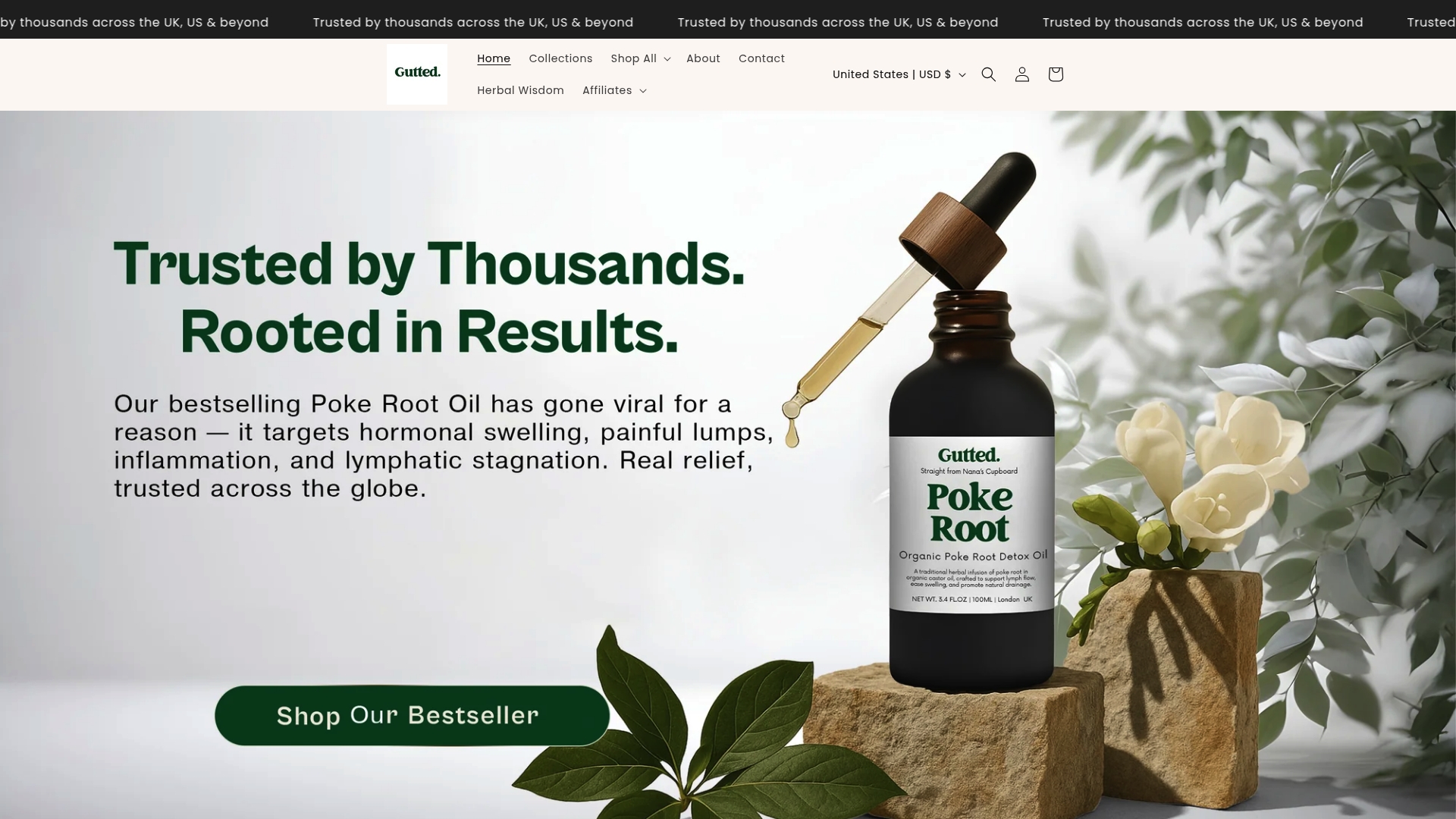
Alongside our flagship oil, we offer Soursop Leaves, Apricot Kernels, and Essiac tea blends, all selected to complement internal balance and detox support. Every batch is small, every ingredient is traceable, and every product is designed with your safety and wellbeing in mind. If you are ready to explore what responsible herbal wellness looks like in practice, our full range and supporting resources are available at Gutted.
Frequently asked questions
Are herbal remedies safe for lymphatic swelling?
Herbal remedies can support mild swelling when chosen carefully, but herbs may interact with medications and are not suitable for everyone. Always consult a health professional before starting, especially if you are pregnant or on prescription medicines.
What does the NHS recommend for lymphoedema management?
NHS guidance does not recommend herbal remedies for lymphoedema. The NHS prioritises compression therapy, structured exercise, skin care, and a balanced diet as the primary management tools.
Which herb is best for inflammation?
Turmeric, ginger, and garlic are linked to anti-inflammatory benefits and have the most consistent study support. Standardised extracts tend to outperform whole-food quantities for measurable anti-inflammatory effects.
Can I use herbs for fluid retention?
Horse chestnut has the strongest evidence for reducing fluid-related swelling, with a 32.1ml leg volume reduction documented in trials. Burdock and cleavers are used traditionally but have limited clinical evidence; medical advice is recommended before use.
How do herbs compare to conventional treatments for lymphatic congestion?
Herbal extracts for lymphatic drainage lack robust evidence compared to standard therapies. Manual lymphatic drainage and compression therapy consistently outperform herbal remedies in clinical settings for lymphatic congestion.