

How herbal products support self-care for swelling: 2026
TL;DR:
- Herbal products are supportive adjuncts and not primary treatments for swelling and lymphatic issues.
- Effective management focuses on compression, exercise, and skincare, with herbs offering mild benefits when used carefully.
- Always consult healthcare professionals before using herbs, especially if experiencing severe or unexplained swelling.
Many people across the UK reach for herbal products when swelling, inflammation, or a sluggish lymphatic system becomes a daily concern. It is easy to see why. Herbal remedies carry centuries of traditional use behind them, and the appeal of a natural solution is strong. But the evidence does not always match the expectation. Herbal products play a supportive, not primary, role in managing swelling and lymphatic health. This guide clarifies what they can and cannot do, which herbs have the most evidence behind them, and how to use them safely alongside the care your body actually needs.
Table of Contents
- Understanding the limits and promise of herbal products for self-care
- Key herbs for inflammation and swelling: what the research shows
- Herbs for lymphatic health: traditional use vs evidence
- How herbal products work: mechanisms, safety, and what to avoid
- Why balancing herbal self-care with medical advice matters
- Explore safe and effective herbal support with Gutted
- Frequently asked questions
Key Takeaways
| Point | Details |
|---|---|
| Herbs supplement self-care | Herbal products can gently support swelling and inflammation but should not replace medical treatment. |
| Best-evidence herbal options | Turmeric, boswellia, GLA oils, and ginger show the strongest evidence for relieving pain and inflammation. |
| Traditional use vs proof | Many herbs are used for lymphatic or swelling support, but evidence for these effects is weaker than for anti-inflammatories. |
| Safety always comes first | Check for product quality, drug interactions, and consult your GP before starting any herbal supplement. |
Understanding the limits and promise of herbal products for self-care
Herbal products are among the most widely used complementary approaches for swelling, inflammation, and lymphatic issues in the UK. Walk into any health shop and you will find shelves lined with tinctures, teas, and capsules making broad claims. The reality, according to current evidence and NHS guidance, is considerably more measured.
The NHS does not endorse herbal medicines for lymphoedema. NHS guidance is clear: compression garments, structured exercise, and consistent skincare form the foundation of lymphoedema management. Herbs are not part of that approved framework. This does not mean herbs are useless. It means they are an adjunct, not a solution.
“Compression, exercise, and skincare are primary. Herbal products are not NHS-approved for lymphatic swelling.” This distinction matters when you are making decisions about your self-care.
There are also real risks worth knowing. Drug interactions are the most significant concern. Herbs such as St John’s Wort can interfere with blood thinners, contraceptives, and antidepressants. Some products may also be contaminated if sourced without proper quality controls. And using herbs inappropriately for serious swelling can delay the medical care that is actually needed.
Common myths vs facts:
- Myth: Herbs cure swelling. Fact: They may reduce mild inflammation when used alongside evidence-based care.
- Myth: Natural means safe. Fact: Herbs carry real risks, especially with other medicines.
- Myth: More is better. Fact: Higher doses increase the risk of side effects and interactions.
- Myth: Herbal products work the same for everyone. Fact: Individual response varies significantly.
For herbal self-care guidance that is grounded in evidence rather than marketing, it helps to start with what is actually registered and regulated.
Pro Tip: Look for products carrying the Traditional Herbal Registration (THR) mark. This UK-specific designation confirms that a product has been assessed for quality and safety by the MHRA, even when clinical evidence is limited.
Key herbs for inflammation and swelling: what the research shows
Some herbs do have meaningful evidence behind them, particularly for inflammation and pain associated with conditions like osteoarthritis and rheumatoid arthritis. The key is knowing which ones and what the data actually says.
Turmeric (specifically its active compound, curcumin) is the most studied. Multiple meta-analyses show pain reduction in arthritis patients. Boswellia, derived from the resin of the Boswellia tree, has also been evaluated in clinical trials. GLA (gamma-linolenic acid) oils, found in evening primrose and starflower oil, have been assessed in Cochrane reviews.
| Herb | Mechanism | Effect size (approximate) |
|---|---|---|
| Turmeric (curcumin) | Anti-inflammatory, NF-kB inhibition | Moderate pain reduction |
| Boswellia | 5-LOX pathway inhibition | 17 points improvement on OA pain scale |
| GLA oils | Prostaglandin modulation | ~33 points on 100-point scale |
| Ginger | COX-2 inhibition | Mild to moderate benefit |
These figures are encouraging, but context matters. Effect sizes vary across studies, and most trials are short-term. None of these herbs replace medical treatment. They may be a useful addition for people managing chronic, low-level inflammation.
How to use top inflammation herbs in your self-care:
- Check with your GP before starting any herbal supplement, particularly if you take other medicines.
- Look for the THR mark or a reputable licensed manufacturer.
- Start with one herb at a time to monitor your response.
- Follow the recommended dose on the product label.
- Give it four to six weeks before assessing any effect.
Pro Tip: Single-ingredient products are easier to evaluate. If you experience a side effect, you will know immediately which herb is the likely cause, rather than guessing among several.
For a broader look at natural swelling remedies, turmeric consistently offers the most robust body of evidence compared with most traditional herbs used for similar purposes.
Herbs for lymphatic health: traditional use vs evidence
This is where the gap between tradition and clinical evidence becomes most apparent. Several herbs are widely promoted for lymphatic drainage and fluid balance, but robust scientific backing is scarce.
Popular herbs used for lymphatic support include:
- Cleavers (Galium aparine): traditionally used as a lymphatic tonic and mild diuretic
- Red clover: used for fluid congestion and hormonal balance
- Calendula: applied topically and taken internally for inflammation and fluid movement
- Dandelion: well-regarded as a gentle diuretic, used to support fluid elimination
These traditional herbs are used as mild diuretics and lymphatic tonics, but evidence from randomised controlled trials is limited or absent.
| Traditional claim | Current evidence |
|---|---|
| Improves lymph flow | No RCT endorsement |
| Reduces fluid retention | Weak diuretic effect in small studies |
| Supports immune signalling | Mostly preclinical (lab-based) data |
| Reduces swelling | Anecdotal and tradition-based |
There is no MHRA THR-registered product specifically for lymphatic swelling at present. Arnica is a notable exception, with a THR registration for the topical treatment of bruising and minor swelling. Sage has specific registered uses as well. But for general lymphatic drainage, the market remains largely unregulated in terms of clinical proof.
You can explore lymphatic detox herbs and the herbal remedy comparison to understand what products are available and how they differ. The honest summary: tradition has value as a starting point for research, but it is not the same as clinical evidence.
How herbal products work: mechanisms, safety, and what to avoid
Understanding how these herbs act in the body helps set realistic expectations. The three main mechanisms relevant to swelling and inflammation are anti-inflammatory action, mild diuretic effect, and influence on immune signalling pathways.
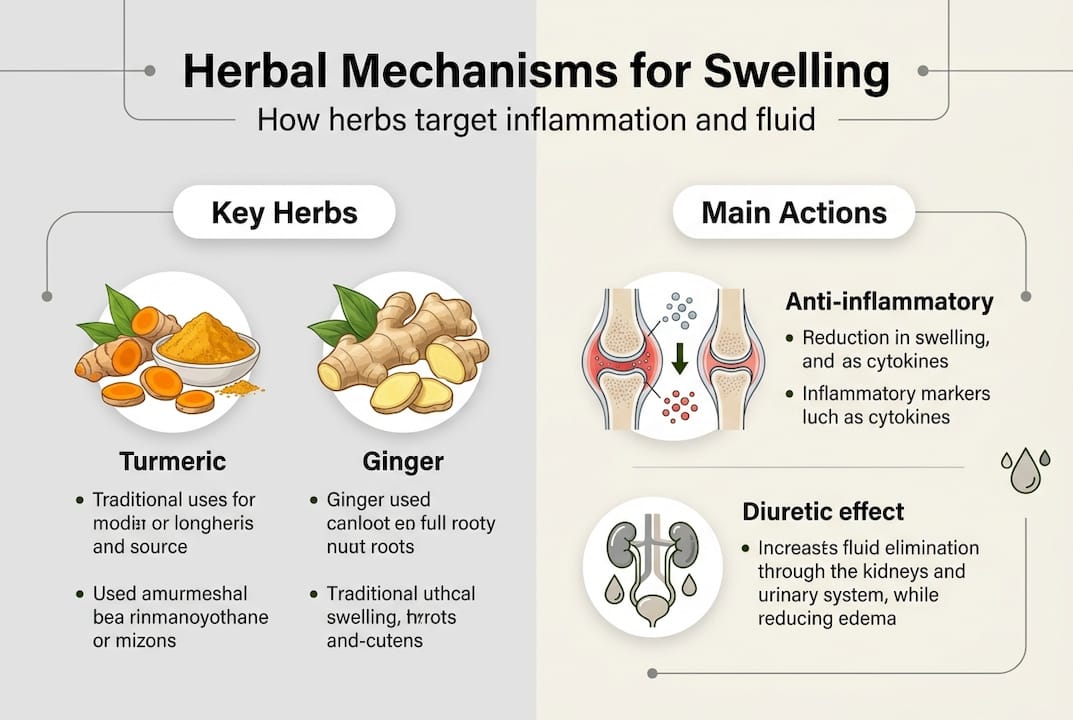
Curcumin inhibits NF-kB, a key protein complex involved in driving inflammation. Boswellia blocks the 5-LOX enzyme, which produces inflammatory leukotrienes. Herbs like dandelion and cleavers act as mild diuretics, increasing urine output and potentially reducing fluid build-up in tissues. None of these effects are dramatic, but they are real.
Who should avoid herbal products:
- Pregnant or breastfeeding individuals (many herbs are contraindicated)
- People with kidney or liver disease
- Those taking blood thinners, diuretics, or immunosuppressants
- Children, unless specifically directed by a paediatrician
- Anyone awaiting or recovering from surgery
The NHS advises that herbal medicines carry a real risk of interactions, particularly with prescribed medicines, and encourages patients to report side effects via the Yellow Card scheme.
Pro Tip: If you have a diagnosed health condition or take any regular medication, speak with your GP before adding any herbal supplement. This is not a formality. It is a genuinely important safety step.
For herbal product safety tips and guidance on what to watch for, knowing the red flags is as important as knowing the benefits. Sudden swelling in one limb, swelling accompanied by redness or warmth, or swelling that appears without an obvious cause all require prompt medical attention. These are not situations where herbal products are appropriate as a first response.
Why balancing herbal self-care with medical advice matters
There is a pattern worth addressing directly. Self-care content online often over-emphasises herbal products while quietly underplaying the straightforward, evidence-backed strategies that consistently make the most difference: compression, movement, skin integrity, and regular medical review.
Traditional knowledge has genuine value. Centuries of use across cultures is not nothing. But using that tradition as a reason to bypass current evidence creates real risk. People delay medical assessment. They spend money on products that may not help. And in some cases, they use herbs that interact with medicines they already take.
The balanced position is this: herbs can serve as a useful adjunct when chosen carefully and used alongside proven approaches. They are not a replacement. Not for lymphoedema management. Not for acute inflammation. Not for serious swelling with an unknown cause.
For practical ideas on gentle swelling relief that sit alongside herbal use, the most effective strategies tend to combine movement, positioning, appropriate garments, and lifestyle adjustments. Herbs fit within that picture, not at the centre of it. Stay sceptical of any product that promises dramatic results where medical treatments have limited effect.
Explore safe and effective herbal support with Gutted
If you have read this far, you understand that safe herbal self-care is about informed choices, not impulse purchases. At Gutted, we build our products and resources around that same principle.
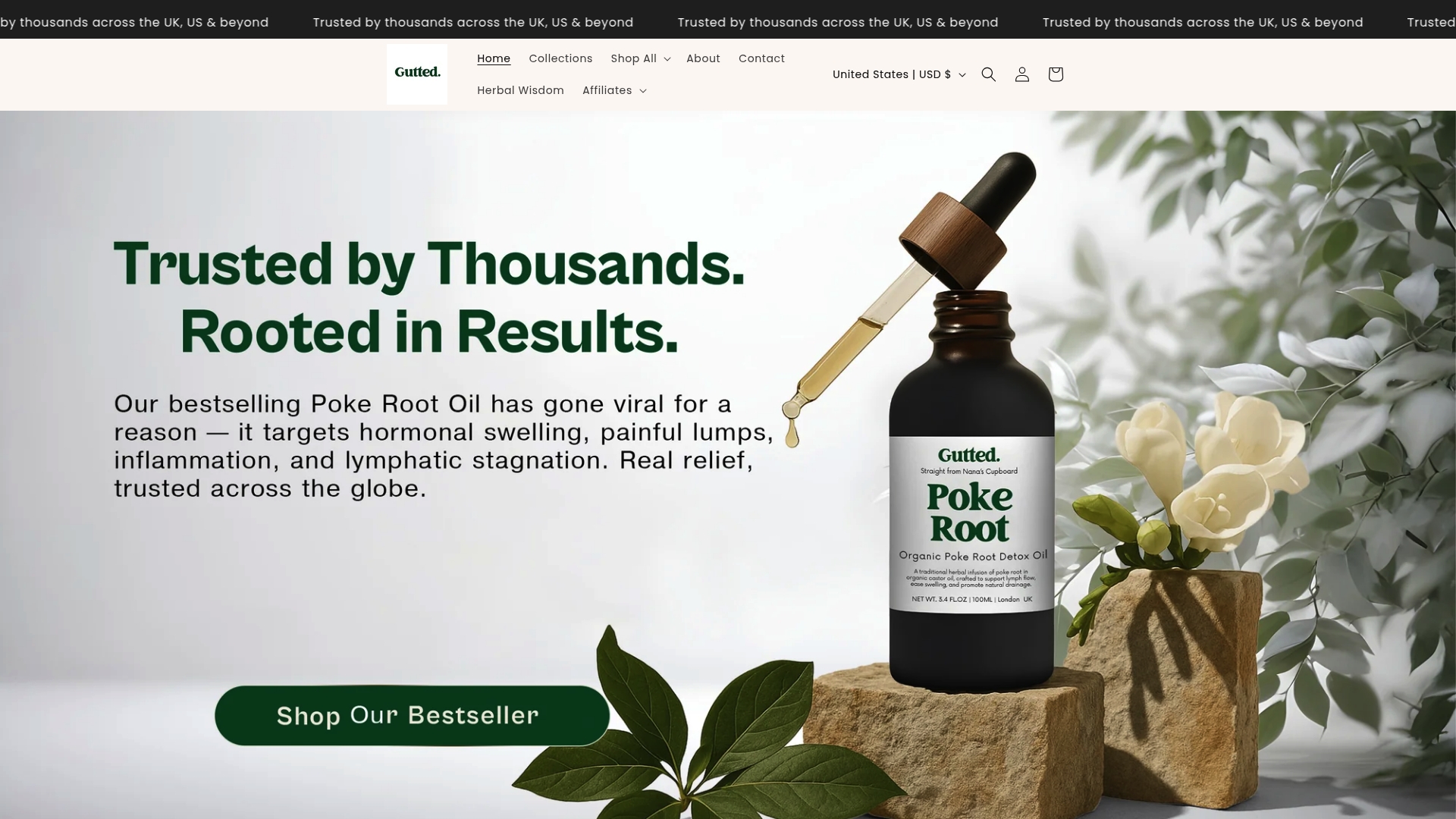
Our Gutted herbal products are handcrafted in small batches using traditional slow-infusion methods, including our Organic Poke Root Oil infused in Castor Oil, designed to support lymphatic drainage and ease areas of discomfort. We also offer Soursop Leaves, Apricot Kernels, and Essiac tea blends to complement internal balance. Explore our full range of herbal wellness for swelling resources and product guides to find what fits your self-care routine.
Frequently asked questions
Are herbal products effective for lymphatic drainage?
There is little strong evidence that herbal products directly improve lymphatic drainage. Most effects are mild and rooted in traditional use rather than clinical trials.
Which herbs are best for inflammation and swelling?
Turmeric, boswellia, GLA oils, and ginger have the most evidence. Cochrane reviews support their use for reducing inflammation and pain in conditions like osteoarthritis.
Are herbal products safe for everyone?
No. The NHS warns of interactions with diuretics, blood thinners, and other prescribed medicines. Always speak with your GP before starting herbal supplements, particularly if you have an existing condition.
What should I do if swelling worsens despite using herbs?
Seek medical care promptly. Worsening or sudden swelling requires NHS or GP assessment. Herbal products should never replace medical treatment for acute or unexplained swelling.