

Herbal products for inflammation and lymphatic health
TL;DR:
- Herbal extracts like turmeric and Boswellia show comparable short-term relief for inflammation with fewer side effects than pharmaceuticals.
- Lymphatic-support herbs such as cleavers and dandelion aid fluid clearance and immune regulation, but require more clinical evidence.
- Combining high-quality, standardised herbal formulations with lifestyle measures enhances safety and effectiveness for mild inflammation and lymphatic health.
Many assume that only pharmaceuticals offer meaningful relief for inflammation and swollen lymph nodes. That assumption is increasingly hard to defend. A growing body of clinical research shows that specific plant extracts act on the same biological pathways targeted by synthetic drugs, sometimes with comparable short-term results and fewer side effects. This guide covers how key herbal products work, what the evidence actually supports, which botanicals are best suited to inflammation versus lymphatic congestion, and how to use them safely alongside modern healthcare. If you want informed choices rather than guesswork, this is the right starting point.
Table of Contents
- How herbal products target inflammation and lymphatic issues
- Key anti-inflammatory and lymphatic herbs explained
- How effective are herbal products in practice?
- Safe use, combinations, and best practices
- Our perspective: Why you shouldn’t overlook evidence-based herbal strategies
- Find trusted herbal blends for your wellness journey
- Frequently asked questions
Key Takeaways
| Point | Details |
|---|---|
| Evidence backs select herbs | Turmeric, Boswellia, and bromelain offer proven support for mild inflammation and swelling when used properly. |
| Lymphatic support needs care | Herbal blends may aid lymph flow, but NHS guidelines still prioritise clinical therapies over natural products. |
| Safety should always come first | Herbal remedies can interact with medicines, so always seek professional advice when starting something new. |
| Best results come from synergy | Combining standardised herbal extracts with evidence-based therapies and expert guidance leads to safer, more effective outcomes. |
How herbal products target inflammation and lymphatic issues
Inflammation is the body’s first-line defence response. It becomes a problem when it persists beyond its useful phase, driving pain, swelling, and tissue damage. The lymphatic system, a network of vessels and nodes running throughout the body, clears cellular waste, excess fluid, and immune cells. When lymph flow slows or becomes congested, fluid pools in tissues, nodes swell, and immune function suffers.
Herbal products address both problems through multiple mechanisms simultaneously. Herbal products for inflammation often work by inhibiting pro-inflammatory pathways like NF-κB, COX-2, and cytokines. This multi-target action is one of their key advantages over single-compound drugs, which typically block only one pathway.
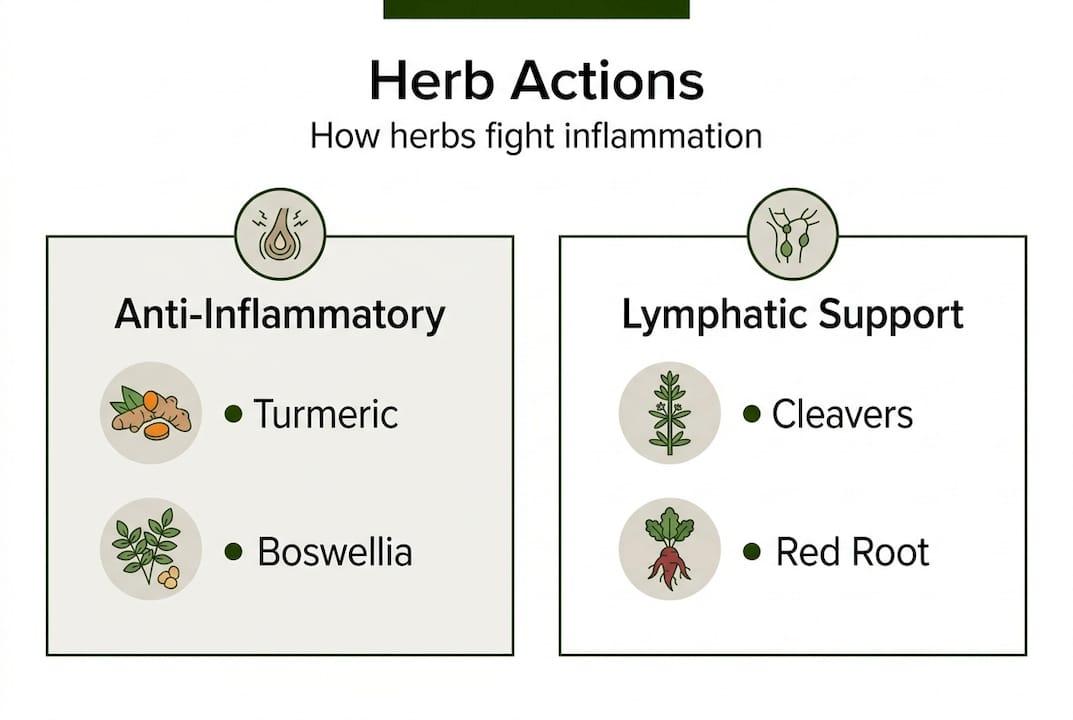
For lymphatic support, the picture is equally interesting. Herbs like cleavers, calendula, echinacea, and dandelion support lymphatic function as lymphagogues and immune modulators, meaning they encourage lymph movement and help regulate immune activity in the nodes themselves. You can read more about lymphatic support explained and how these mechanisms translate to real-world use.
Here is a quick overview of the main categories:
- Anti-inflammatory herbs: Turmeric (curcumin), Boswellia serrata, bromelain (from pineapple stem)
- Lymphatic herbs: Cleavers, calendula, echinacea, dandelion root
- Dual-action options: Red clover, burdock root, poke root
| Herb | Primary action | Key pathway targeted |
|---|---|---|
| Turmeric | Anti-inflammatory | NF-κB, COX-2 |
| Boswellia | Anti-inflammatory | 5-LOX, cytokines |
| Bromelain | Anti-oedema, enzyme | Protease activity |
| Cleavers | Lymphagogue | Lymph flow stimulation |
| Echinacea | Immune modulator | Lymph node immune activity |
| Dandelion | Diuretic, lymphagogue | Fluid clearance |
Pro Tip: Look for standardised extracts rather than raw herb powders. Standardised products guarantee a consistent level of active compound per dose. Combine fat-soluble herbs like curcumin with a meal containing healthy fats, or pair with piperine from black pepper, to significantly improve absorption.
Key anti-inflammatory and lymphatic herbs explained
With this foundation, let’s break down the top herbs you’ll encounter and how each stands up to the science.
Turmeric (curcumin) is the most studied anti-inflammatory herb in clinical settings. Curcumin blocks NF-κB and COX-2 activity, reducing the production of inflammatory signalling molecules. Its main limitation is poor absorption when taken alone, which is why formulations combining it with piperine or phospholipid complexes are preferred.
Boswellia serrata targets the 5-lipoxygenase (5-LOX) pathway, which is distinct from the COX pathway that most NSAIDs address. This makes it a useful option for people who do not tolerate standard anti-inflammatory drugs well. In a Cochrane review on herbal therapy, Boswellia serrata reduced osteoarthritis pain by 17 points on a 0 to 100 scale versus placebo, and GLA oils reduced rheumatoid arthritis pain by 33 points.

Bromelain is a protease enzyme derived from pineapple stem. It breaks down proteins involved in the inflammatory cascade and has demonstrated measurable effects on post-surgical and injury-related oedema. A multi-component formula with Melilotus and bromelain reduced oedema by up to 34% in preclinical and clinical studies.
For lymphatic support, explore examples of lymphatic herbs that have both traditional and emerging empirical backing:
- Drink cleavers as a cold-infused tea (steep overnight in cold water) to preserve its delicate active compounds.
- Use calendula topically as an infused oil for localised lymph node areas.
- Take echinacea in short cycles (up to 8 weeks) to support immune activity without overstimulation.
- Add dandelion root tea to your morning routine for gentle diuretic and lymph-clearing support.
- Consider a herbal remedies comparison to match specific herbs to your individual needs.
| Herb | Typical use | Evidence grade | Safety overview |
|---|---|---|---|
| Turmeric | Inflammation, joint pain | Moderate | Generally safe; avoid high doses in pregnancy |
| Boswellia | Joint pain, oedema | Moderate | Well tolerated; rare GI upset |
| Bromelain | Oedema, post-injury | Moderate | Avoid with blood thinners |
| Cleavers | Lymph congestion | Traditional/empirical | Very safe; no known interactions |
| Echinacea | Immune/lymph support | Low to moderate | Avoid in autoimmune conditions |
| Dandelion | Fluid retention, lymph | Traditional/empirical | Caution with diuretic medications |
How effective are herbal products in practice?
So, what does the evidence really say about the effectiveness of these products for inflammation and lymphatics?
The honest answer is: it varies by herb, condition, and product quality. Here is what recent clinical trials and meta-analyses consistently show:
- Moderate evidence for turmeric and Boswellia places them comparable to NSAIDs in the short term, though sceptics rightly note low bioavailability and study limitations in many trials.
- Bromelain and Melilotus combinations show measurable reductions in soft-tissue oedema, with the 34% reduction figure cited above being one of the stronger data points in this category.
- For lymphatic herbs specifically, limited robust evidence exists in humans, and current clinical guidelines do not recommend herbal extracts as a primary treatment for diagnosed lymphedema.
“The evidence base for herbal anti-inflammatories is moderate and growing, but for lymphatic-specific herbs in clinical lymphedema, further well-designed human trials are needed before firm recommendations can be made.”
This nuance matters. Herbal products are not uniformly supported or uniformly dismissed. Their real-world value depends on which herb, which condition, and how well the product is formulated.
For natural ways to reduce swelling and support fluid clearance, herbs work best as part of a broader approach that may include movement, hydration, and herbal lymph massage techniques.
Pro Tip: Herbal products are well suited to mild, ongoing symptoms and general wellness support. For persistent swelling, unexplained lymph node enlargement, or severe inflammation, consult your GP before relying on any supplement.
Safe use, combinations, and best practices
Understanding both the potential and the limits, here is how to choose and use herbal products safely in your wellness plan.
Start with the label. A quality herbal product will state the plant species in full (e.g., Curcuma longa), the part of the plant used (root, leaf, stem), the extraction ratio or standardised percentage of active compound, and the batch or lot number. If any of these are missing, treat the product with caution.
Safe pairings and practical guidance:
- Curcumin plus piperine: Piperine increases curcumin absorption by up to 2,000%. Always take with food containing fat.
- Dandelion blends: Pair with cleavers for a gentle combined lymph and fluid-clearing effect.
- Echinacea cycles: Use for 6 to 8 weeks, then take a break of equal length.
- Avoid with blood thinners: Bromelain, ginger, and high-dose turmeric can potentiate anticoagulant medications.
- Pregnancy caution: Avoid high-dose Boswellia, bromelain, and poke root during pregnancy without medical supervision.
For broader guidance on how to boost lymphatic flow naturally, combining herbs with movement and manual drainage techniques produces better outcomes than herbs alone. Herbal blends for immune support can also complement a lymphatic-focused routine when the immune system needs additional attention.
The expert consensus is clear: herbal products should be combined with evidence-based therapies for lymphatic conditions, bioavailability should be actively managed through formulation choices, and GP consultation is essential if you take any prescription medication. You can also explore how lymphatic herbs are used in practice for additional context on traditional and clinical applications.
Pro Tip: Natural does not automatically mean safe. Some herbs interact with common medications including statins, blood pressure drugs, and anticoagulants. Always disclose new supplements to your GP or pharmacist.
Our perspective: Why you shouldn’t overlook evidence-based herbal strategies
The loudest critics of herbal products tend to focus on the weakest examples: poorly standardised powders, implausible claims, and studies using inadequate doses. That critique is valid for those products. It is not valid for the category as a whole.
High-quality curcumin extracts, standardised Boswellia, and enzyme-based formulations like bromelain have genuine clinical trial data behind them. Dismissing all herbal products because some are poorly made is like dismissing all pharmaceuticals because some fail in trials.
What most people miss is that the real question is not “natural versus synthetic.” It is “does this specific product, at this dose, in this formulation, address my specific condition?” That is the same question you should ask of any intervention.
For those who want to avoid pharmaceuticals where possible, the evidence supports selective, informed herbal use for mild to moderate inflammation and general lymphatic wellness. The strategy that works is integrating botanical blends for wellness with professional guidance, not replacing one dogma with another.
Herbs are not magic. Neither are synthetics. The winning approach is informed, evidence-led choice.
Find trusted herbal blends for your wellness journey
Choosing the right herbal product starts with knowing the source. Quality matters more than marketing claims, and the difference between a standardised extract and a generic powder can determine whether you see results or not.
At Get Gutted, every product is handcrafted in small batches using traditional slow-infusion methods, from our Organic Poke Root Oil in Castor Oil to our Soursop Leaves, Apricot Kernels, and Essiac tea blends. Each formula is selected specifically to support lymphatic drainage, reduce fluid retention, and ease inflammation naturally. Evidence-based guides and clear product explanations are available throughout the site to help you make genuinely informed choices rather than guesses.
Frequently asked questions
Which herbal products are best supported by evidence for inflammation?
Turmeric (curcumin extract), Boswellia serrata, and bromelain have the strongest evidence for reducing mild inflammation and pain, with moderate evidence in clinical trials placing them alongside NSAIDs for short-term symptom relief.
Are herbal products safe for everyone?
Not always. Some herbs interact with medications including blood thinners and statins, and certain herbs are unsuitable during pregnancy. Always consult your GP before starting new supplements.
Can lymphatic herbal products replace medical treatments?
No. Herbal products may support general lymph health and fluid clearance, but they should not replace NHS-recommended MLD or compression therapy for diagnosed lymphedema, as no clinical guideline currently recommends herbals as a primary treatment.
How can I improve absorption of herbal anti-inflammatories?
Combine curcumin with piperine from black pepper and always take it with a meal containing healthy fats. This approach is supported by bioavailability research and can dramatically increase the amount of active compound your body actually absorbs.
What are the signs a herbal product is working?
Look for reduced swelling, less stiffness or discomfort, and gradual improvements in mobility and general well-being. Clinical trials show that meaningful symptom improvements typically appear within 4 to 12 weeks for well-evidenced herbal products.