

Cold and warm herbal compress method: your safe home guide
Warm herbal compresses relax tight muscles and improve local circulation; cold herbal compresses reduce acute inflammation and swelling by constricting blood vessels. Both methods can use the same herb brew, just at different temperatures. The cold and warm herbal compress method draws from Thai luk pra kob tradition, and with the right safety limits, you can use both at home.
Quick safety limits before you start:
- Adults: warm compress no hotter than 49 °C (120 °F); cold compress applied for 5–15 minutes per session
- Children: warm compress no hotter than 41 °C (105 °F); always use a cloth barrier for cold
- Infants: warm compress no hotter than 38 °C (100 °F); cold compresses are generally not recommended without medical guidance
- Warm application time: 10–20 minutes per session for adults
- Test first: press the compress against your inner wrist before applying anywhere else; if it stings or feels uncomfortably cold, adjust before proceeding
- Change the cloth as soon as it reaches body temperature to maintain the therapeutic effect
Getgutted offers ready-made herbal wellness kits for those who prefer a vetted, small-batch blend rather than sourcing herbs individually.
Table of Contents
- What is a Thai herbal compress (luk pra kob)?
- Cold versus warm: which should you choose?
- What temperature and timing are safe at home?
- Which herbs work in a Thai-style compress?
- How to prepare and apply a warm herbal compress
- How to prepare and apply a cold herbal compress
- When should you avoid herbal compresses?
- Why does it work? The physiology behind heat, cold and herbs
- Simple UK-friendly DIY recipes and storage guidance
- How to choose a ready-made herbal compress kit
- Key takeaways
- Why traditional herbal compresses still deserve a place in modern self-care
- Getgutted wellness kits: ready-made blends for compress therapy
- Useful sources and further reading
What is a Thai herbal compress (luk pra kob)?
Luk pra kob translates roughly as “herbal pressing ball.” A bundle of dried or fresh herbs is wrapped tightly in muslin or cotton, steamed until fragrant and hot, then pressed, patted and rolled along the body in a rhythmic sequence. The combination of moist heat, aromatic vapour and sustained pressure is what distinguishes it from a simple hot towel.
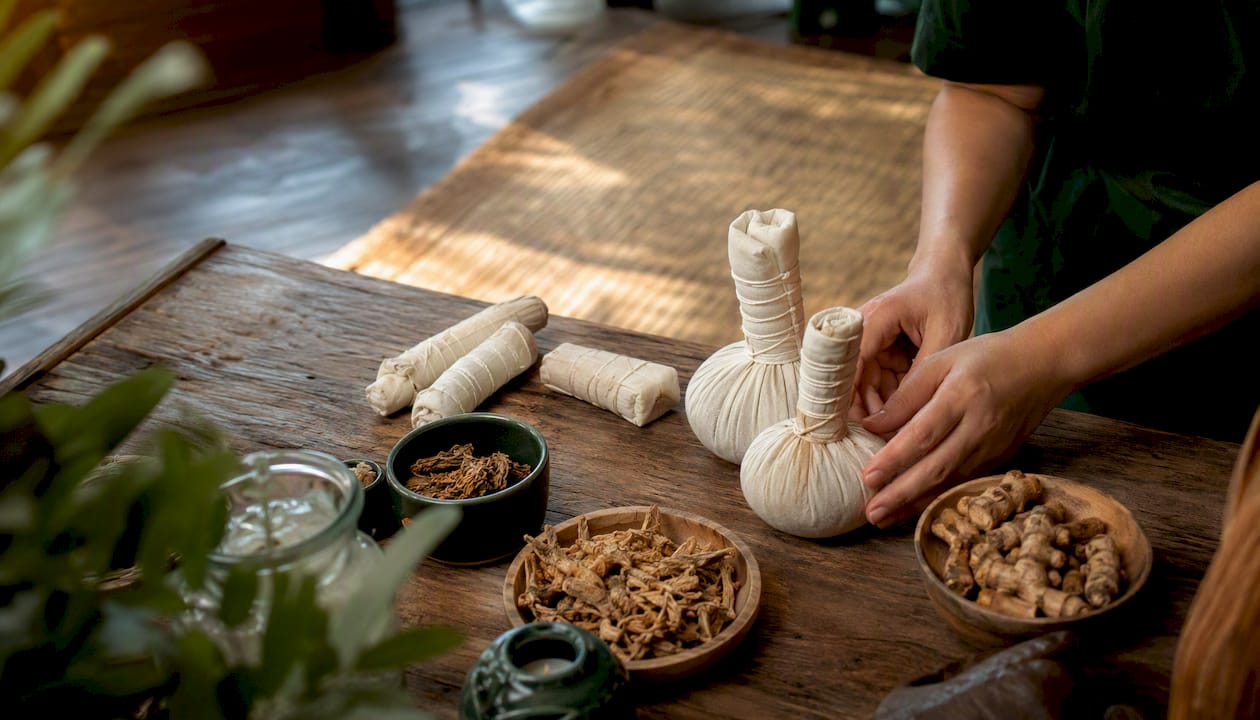
The technique originates in Thai traditional medicine, where practitioners work along sen lines, the body’s energy pathways, in a manner analogous to meridians in Chinese medicine. Historically it was used in royal courts and temple medicine to treat soldiers returning from battle with bruised muscles and joint stiffness.
In a professional session, the therapist works with two compresses simultaneously, alternating between them so one is always reheating on the steamer while the other is in use. Home users typically work with one compress at a time, which is perfectly effective for self-treatment.
Cold versus warm: which should you choose?
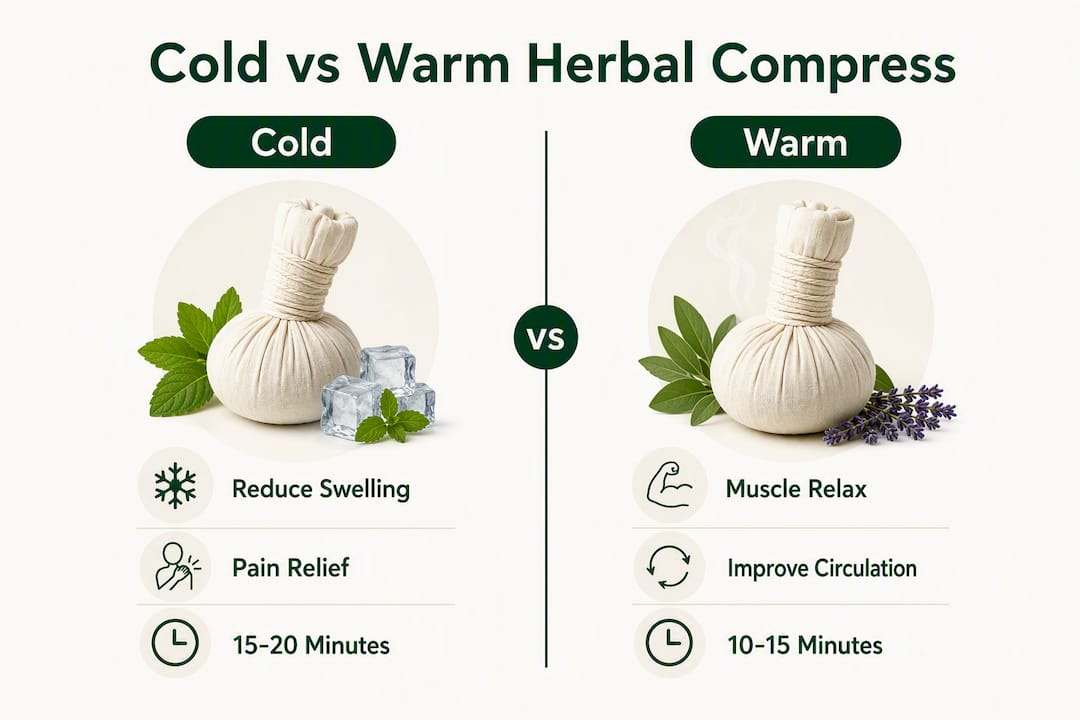
The decision comes down to one question: is the problem acute (recent, hot, swollen) or chronic (ongoing, stiff, achy)?
Use a warm compress for:
- Chronic muscle tension and stiffness
- Poor local circulation or cold, tight joints
- Menstrual cramps
- Sinus congestion (held near, not on, the face)
- Muscle spasms that have been present for more than 48 hours
Use a cold compress for:
- Acute sprains and strains within the first 48 hours
- Fresh bruises
- Insect bites and localised allergic skin reactions
- Active swelling with heat and redness
- Headaches centred at the temples or forehead
Quick decision checklist:
- Did the injury or pain start within the last 48 hours? Start cold.
- Is the area visibly swollen, red or warm to the touch? Stay cold.
- Is the problem chronic, recurring or stiff rather than inflamed? Use warm.
- No swelling, no acute injury, just aching muscles? Warm is your friend.
Individual response genuinely varies. Some people find cold unbearable on a muscle spasm and get faster relief from warmth; others find a warm compress on a fresh bruise makes it worse. The guidelines help, but pay attention to what your body tells you.
Pro Tip: For a sprain that has moved past the initial 48-hour acute phase, alternating warm and cold can reduce residual swelling while restoring circulation. Apply cold for 5 minutes, then warm for 10 minutes, and repeat the cycle twice. Always finish on cold if swelling is still present.
What temperature and timing are safe at home?
Getting the temperature wrong is the most common mistake with herbal compresses, and the consequences range from a mild scald to a genuine burn, particularly on children or anyone with reduced skin sensitivity.
| Group | Max warm temperature | Warm application time | Cold application time |
|---|---|---|---|
| Adults | 49 °C (120 °F) | 10–20 minutes | 5–15 minutes |
| Children | 41 °C (105 °F) | 10 minutes maximum | 5 minutes maximum |
| Infants | 38 °C (100 °F) | 5 minutes; medical guidance advised | Not recommended |
Sources: NHS heat and cold therapy guidance; Drugs.com topical heat/cold safety
Practical safety steps:
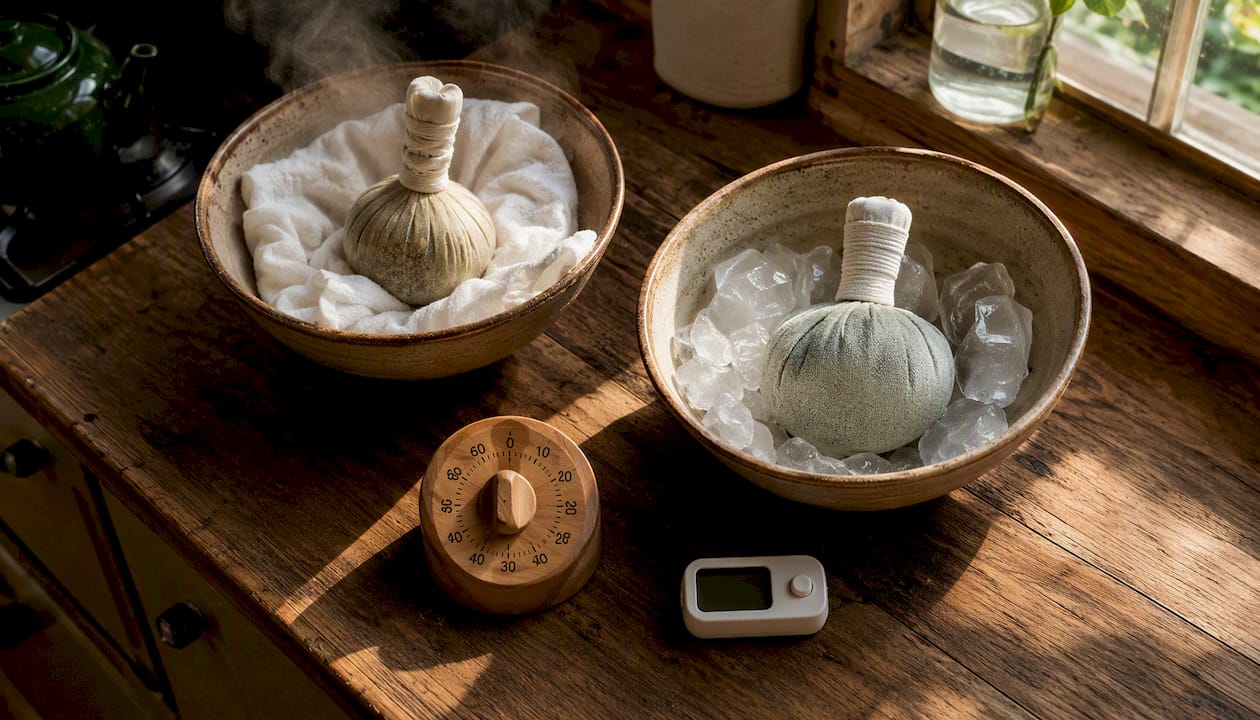
- Always test a warm compress on the inner wrist for 5 seconds before applying to the target area
- For cold compresses, wrap the cloth or ice pack in a thin cotton layer; never apply ice directly to skin
- If the skin turns bright red, develops a rash or blisters, remove the compress immediately and do not reapply
- Re-soak or replace the cloth the moment it reaches body temperature; a lukewarm compress provides no therapeutic benefit and a contaminated cloth on inflamed skin risks irritation
- Do not apply a warm compress to the same area more than three times in a day
- For cold therapy, allow the skin to return to normal temperature between applications before reapplying
Children and elderly people have thinner, more sensitive skin. Even at the “safe” thresholds above, check the skin every 2–3 minutes during the first session. People with diabetes, peripheral neuropathy or any condition that reduces skin sensation should seek medical advice before using either method at home, as they cannot reliably detect when a compress is too hot or too cold.
Which herbs work in a Thai-style compress?
Traditional Thai herbs and what they do
- Ginger (Zingiber officinale): warming, stimulates circulation, mildly anti-inflammatory
- Lemongrass (Cymbopogon citratus): aromatic, antimicrobial, relieves muscle tension
- Turmeric (Curcuma longa): anti-inflammatory, gives the compress its characteristic yellow tint (it will stain light fabric)
- Galangal (Alpinia galanga): warming, related to ginger, used for joint pain
- Kaffir lime leaf and zest (Citrus hystrix): aromatic, uplifting, skin-toning
- Camphor: strongly aromatic, cooling sensation, used sparingly; avoid entirely during pregnancy
- Eucalyptus leaf: decongestant, antimicrobial, excellent for sinus and respiratory compresses
UK-friendly substitutions
Fresh ginger root is available in virtually every UK supermarket and is an excellent substitute for galangal. Dried lemongrass from Asian grocery shops works well when fresh is unavailable. For a gentler blend, chamomile and calendula flowers (widely stocked in UK health food shops) replace kaffir lime and camphor with a calming, skin-soothing effect. Lavender, grown across the UK, substitutes for eucalyptus in blends aimed at relaxation rather than decongestion.
For herbal remedies targeting chronic inflammation, turmeric and ginger remain the most accessible and well-evidenced options for UK buyers.
Allergy and sensitivity notes
Camphor and cayenne are the two herbs most likely to cause topical irritation. Start with a lower concentration (half the usual quantity) in your first batch and increase only if your skin tolerates it. Anyone with a known sensitivity to the Asteraceae family (ragweed, chrysanthemum) should avoid chamomile and calendula. Citrus-based herbs can increase photosensitivity; do not apply a compress containing kaffir lime or lemon zest and then expose that skin to direct sunlight.
How to prepare and apply a warm herbal compress
What you need
- 30–45 g (3–4 tablespoons) of dried herbs, or roughly double that if using fresh
- 500 ml water
- A steamer basket or a heatproof bowl set over a saucepan
- Two squares of muslin or thin cotton, roughly 30 cm × 30 cm
- Kitchen string or a rubber band to tie the bundle
- A clean towel to protect the skin if needed
- An optional kitchen thermometer
Step-by-step method
- Make the bundle. Place your herbs in the centre of the muslin square. Gather the corners, twist firmly and tie with string to create a tight ball. The herbs should be compact, not loose.
- Steam the compress. Place the bundle in a steamer basket over simmering water. Steam for approximately 15 minutes until the compress is thoroughly hot and fragrant.
- Test the temperature. Remove the compress with tongs and press it against your inner wrist for 5 seconds. It should feel warm and comfortable, not scalding. If it stings, wait 30–60 seconds and test again.
- Apply using traditional motions. Press the compress firmly onto the target area and hold for 5–10 seconds (press and hold). Then use small circular movements (press and circle). For larger muscle groups such as the back or thighs, roll the compress slowly along the muscle belly. For tight spots, use a gentle press-and-stretch motion, pressing the compress down as you lightly stretch the surrounding skin.
- Maintain pressure with body weight. Rather than pushing with your arm, lean your body weight into the compress with a straight arm. This delivers consistent pressure without tiring your hand.
- Re-steam as needed. Once the compress cools to body temperature, return it to the steamer for 3–5 minutes before continuing. Do not skip this step; a lukewarm compress is not effective.
- Finish the session. After 10–20 minutes of application, remove the compress and allow the skin to cool naturally. Pat dry with a clean towel.
Pro Tip: Keep a second compress bundle in the steamer throughout the session. Alternating between the two means you always have one at the right temperature, which is exactly how professional Thai therapists work.
How to prepare and apply a cold herbal compress
Cold herbal compresses use the same herb brew as the warm version, just chilled rather than steamed. There are three practical preparation routes depending on what you have available.
What you need
- A prepared herbal infusion (see the DIY recipes section below), cooled to room temperature
- A clean muslin cloth or flannel
- A bowl of cold water with ice cubes, or refrigerator space
- Optional: a gel ice pack to wrap inside the cloth for sustained cold
Step-by-step method
- Prepare the infusion. Steep 3–4 tablespoons of herbs in 500 ml of just-boiled water for 20–30 minutes. Strain and allow to cool completely, then refrigerate until cold (at least 1 hour, ideally 2–3 hours).
- Choose your chilling method. For a light cold compress, soak a folded cloth in the chilled infusion and wring it out until damp but not dripping. For stronger, sustained cold, place a gel ice pack inside a herb-infused cloth so the pack delivers cold while the cloth carries the herbal contact.
- Protect the skin. Always place a thin cotton layer between an ice pack and bare skin. Direct ice contact for more than a few minutes can cause cold burns, which look and feel similar to heat burns.
- Apply the compress. Lay the cold cloth over the affected area. For acute sprains, the ankle or knee for example, drape and hold rather than press firmly; pressure on acutely inflamed tissue can increase pain.
- Time the application. Leave in place for 5–15 minutes. Check the skin every 5 minutes; if the area becomes numb, pale or mottled, remove the compress immediately.
- Rest between applications. Allow the skin to return to normal temperature (roughly 10 minutes) before reapplying.
For those wanting a more clinical-grade cold application, the Apiceuticals Soothing Cryotherapy Set offers a controlled-temperature alternative to a DIY ice pack, particularly useful for post-exercise recovery or persistent joint swelling.
Aftercare for cold-treated areas:
- Gently pat the skin dry after removing the compress
- Avoid vigorous movement of the treated joint for at least 30 minutes
- If swelling has not reduced after 48 hours of cold therapy, seek medical advice
- Do not apply heat to an area that is still acutely swollen
When should you avoid herbal compresses?
Herbal compresses are safe for most adults when used correctly, but there are clear situations where you should not use them.
Do not use warm or hot compresses on:
- Open wounds, cuts or broken skin (heat increases infection risk)
- Active skin infections, cellulitis or rashes
- Areas with known blood clots or deep vein thrombosis
- Acute injuries within the first 48 hours (use cold instead)
- During the first trimester of pregnancy, particularly over the abdomen or lower back; camphor-containing blends should be avoided throughout pregnancy
Do not use cold compresses on:
- Areas with poor circulation or Raynaud’s phenomenon
- Skin that is already numb or has reduced sensation
- Open wounds
Red flags: stop and seek medical advice if you notice:
- Blistering or skin discolouration after compress use
- Pain that increases rather than eases during or after treatment
- Spreading redness, warmth or red streaks (possible infection)
- Fever developing alongside local symptoms
- No improvement after 5–7 days of consistent home treatment
Simple aftercare steps:
- After a warm compress session, drink a glass of water; heat increases local fluid movement and mild hydration supports this
- Allow the treated area to cool for 10–15 minutes before covering with clothing
- Gentle, slow movement of the treated joint or muscle after a warm session helps maintain the circulation benefit
- For chronic conditions, keep a brief treatment log: date, compress type, duration, herbs used and your pain level before and after. Patterns become visible within two to three weeks and help you refine your approach
- Avoid reapplying a compress to the same area within 2 hours; for inflamed skin, wait 24–48 hours between sessions
Why does it work? The physiology behind heat, cold and herbs
Heat and cold act on tissue through well-understood mechanisms. Warmth causes local vasodilation, increasing blood flow to the area, which delivers oxygen and nutrients, relaxes muscle spindles and reduces the stiffness associated with chronic tension. Cold causes vasoconstriction, slowing blood flow to the area and reducing the inflammatory mediators that cause swelling and pain in acute injury. Both effects are supported by NHS clinical guidance on heat and cold therapy.
What do the herbs add? The honest answer is: probably less than the temperature, but not nothing. Compounds such as gingerols in ginger, curcumin in turmeric and eucalyptol in eucalyptus have demonstrated anti-inflammatory activity in laboratory settings. In a compress, these compounds are absorbed transdermally in small quantities. The aromatic vapours, particularly from lemongrass, eucalyptus and ginger, also contribute through inhalation during application, which is why a herbal compress session feels qualitatively different from a plain hot towel.
“A randomised controlled trial comparing hot herbal compress, hot compress, and topical diclofenac for myofascial pain syndrome found that hot herbal compress produced meaningful reductions in pain intensity, suggesting the herbal component adds measurable benefit beyond heat alone.”
Systematic reviews of Thai herbal compress therapy for osteoarthritis and muscle pain suggest potential benefit, but researchers consistently call for larger, standardised trials before firm clinical conclusions can be drawn. The clinical evidence base for Thai herbal compresses is promising rather than definitive. That is not a reason to dismiss the method; it is a reason to use it as a complement to medical care rather than a replacement.
The combination of heat, pressure and aromatherapy in a single application is also part of why Thai massage practitioners use compresses to augment manual techniques. Research published by ABMP notes that massage combined with heat increases tissue perfusion and makes stretching more effective, which explains why the compress is applied before and during bodywork rather than only at the end.
Simple UK-friendly DIY recipes and storage guidance
Three practical blends
Warming ginger-turmeric blend (for muscle tension, poor circulation, chronic joint stiffness)
Simmer 4–5 slices of fresh ginger root in 500 ml of water for 10–15 minutes. Remove from heat, add 1 teaspoon of ground turmeric and 2 tablespoons of dried lemongrass. Steep for a further 10 minutes, then strain.
Calming lavender-chamomile blend (for stress-related tension, sensitive skin, mild headaches)
Bring 500 ml of water to just below boiling. Add 3 tablespoons of dried chamomile flowers and 2 tablespoons of dried lavender. Steep off the heat for 20–30 minutes, then strain. Do not simmer; high heat destroys the delicate volatile oils in both herbs.
Anti-inflammatory lemongrass-eucalyptus blend (for sinus congestion, post-exercise muscle soreness, respiratory support)
Steep 3 tablespoons of dried lemongrass and 1 tablespoon of dried eucalyptus leaf in 500 ml of just-boiled water for 20 minutes. Strain. Use warm for muscle soreness; allow to cool fully for a sinus-relief cold compress held near the face.
Brew ratios, timing and shelf life
| Blend | Herb quantity | Water | Steep/simmer time | Steam time | Shelf life |
|---|---|---|---|---|---|
| Ginger-turmeric | 3–4 tbsp (45–60 g) | 500 ml | Simmer 10–15 min, steep 10 min | 15 minutes | Use within 24 hours |
| Lavender-chamomile | 3 tbsp (approx. 15 g) | 500 ml | Steep 20–30 min (no simmer) | 10 minutes | Use within 24 hours |
| Lemongrass-eucalyptus | 4 tbsp (approx. 20 g) | 500 ml | Steep 20 min | 15 minutes | Use within 24 hours |
Preparation ratios based on Drugs.com herbal preparation guidance and The Herbal Medicine Garden.
Each batch yields enough brew for one full session of 2–3 compress applications. Store any unused brew in a sealed glass jar in the refrigerator and use within 24 hours. Reheat gently on the hob; do not microwave, as uneven heating can create hot spots in the cloth. Always use a fresh cloth for each session; reusing the same cloth without washing risks contamination, particularly over inflamed or broken skin.
How to choose a ready-made herbal compress kit
Not everyone wants to source and blend herbs from scratch, and a well-made kit removes most of the guesswork around ratios and cloth quality.
What to look for:
- A full ingredient list with herb names (not just “herbal blend”) and quantities or proportions
- Muslin or unbleached cotton cloth; avoid synthetic fabrics, which do not breathe and can trap heat unevenly
- Clear instructions covering both warm and cold application, including temperature guidance
- No synthetic fragrances; the aroma should come from the herbs themselves
- Small-batch production, which usually means fresher herbs and better quality control
- A clear best-before or harvest date on dried herb components
Red flags:
- No ingredient list or vague labelling (“natural herbs”)
- Artificial fragrance listed as an ingredient
- No safety or temperature guidance included
- Packaging that shows no evidence of the herbs inside (no visible texture, no natural scent when opened)
For holistic herbal support for swelling and inflammation, the herbs in a compress kit should be the same quality you would use internally. If the sourcing is not good enough to drink, it is not good enough to press against inflamed skin.
Getgutted’s wellness kits are produced in small batches with clearly labelled, wild-harvested botanicals, making them a practical starting point for anyone new to compress therapy who wants a vetted blend without the sourcing effort.
Key takeaways
Both warm and cold herbal compress methods are safe and effective at home when you match the temperature to the condition, stay within the recommended thresholds, and use fresh cloths every session.
| Point | Details |
|---|---|
| Match temperature to condition | Use warm for chronic stiffness and muscle tension; use cold for acute swelling and fresh injuries within 48 hours. |
| Respect temperature limits | Adults: warm no hotter than 49 °C; cold applied for a short duration. Reduce both thresholds for children. |
| Test before applying | Press the compress to your inner wrist for 5 seconds; if it stings or numbs, adjust before applying to the target area. |
| Replace cloths every session | Change or re-soak the cloth as it reaches body temperature; reusing a contaminated cloth over inflamed skin risks irritation. |
| Getgutted wellness kits | Getgutted offers small-batch, clearly labelled herbal wellness kits suited to both warm and cold compress preparation. |
Why traditional herbal compresses still deserve a place in modern self-care
There is a tendency in wellness writing to treat anything with a long history as automatically credible, and anything without a large randomised trial as automatically suspect. Neither position is useful.
What strikes me about the luk pra kob tradition is how practically intelligent it is. The combination of moist heat, sustained pressure and aromatic herbs addresses three distinct physiological mechanisms simultaneously: vasodilation, mechanical tissue release and neurological calming through scent. A plain hot water bottle does one of those things. A compress does all three.
The evidence base is still developing, and that is worth saying plainly. The clinical trials that exist, including the PMC randomised controlled trial on myofascial pain, are encouraging but small. What the research does confirm is that the thermal effect is real and measurable, and that the herbal component appears to add something beyond heat alone.
Where I think people go wrong is treating compress therapy as a standalone cure rather than one layer of a self-care routine. Used twice a week alongside gentle movement, adequate hydration and, where relevant, medical treatment, it is a genuinely useful tool. Used instead of seeing a doctor about a worsening injury, it is a delay.
The UK adaptation is simpler than people expect. You do not need galangal or kaffir lime to get a meaningful result. Fresh ginger, dried lemongrass and a handful of lavender from a garden centre will do the job for most applications. The ritual of preparing the compress, the warmth, the scent, the deliberate attention to one part of your body for twenty minutes, is itself part of the benefit.
Getgutted wellness kits: ready-made blends for compress therapy
If sourcing and blending herbs feels like a barrier to getting started, Getgutted has done that work for you.
Getgutted’s wellness kits contain small-batch, wild-harvested botanicals with full ingredient transparency, so you know exactly what you are pressing against your skin. Each kit includes preparation guidance covering both warm and cold application, which means you can use the same blend for a steamed muscle compress on a stiff shoulder or a chilled cloth on a swollen ankle. The herbs are sourced for purity rather than price, and the small-batch production means you are not getting herbs that have been sitting in a warehouse for eighteen months.
Browse the Getgutted wellness kits collection to find the blend that suits your needs, whether that is a warming ginger-based kit for chronic tension or a calming botanical blend for stress and sensitivity.
Useful sources and further reading
The sources below underpin the safety figures, clinical evidence and preparation guidance in this article.
-
NHS heat and cold therapy guidance: The primary UK clinical source for safe application times (10–20 minutes warm; 5–15 minutes cold) and general heat/cold therapy principles. Referenced throughout the safety and physiology sections.
-
Drugs.com topical heat/cold safety and herbal preparation guidance: Source for the specific temperature thresholds used in the safety table (49 °C adults, 41 °C children, 38 °C infants) and the 3–4 tablespoon per cup preparation ratio.
-
PMC — Hot herbal compress vs hot compress vs topical diclofenac for myofascial pain (RCT): A randomised controlled trial demonstrating that hot herbal compress produces measurable pain reduction beyond heat alone; used in the evidence and mechanism section.
-
PMC — Effects of herbal wet compresses on pain and inflammation: Clinical study examining cold and heat compress protocols for pain management; supports the timing and sequencing guidance in the cold compress section.
-
Clinical effects of Thai herbal compress: systematic review (NCBI): Systematic review of Thai herbal compress therapy for osteoarthritis and muscle pain; provides the balanced evidence context in the physiology section.
-
Thai herbal compress training manual, The School of Fine Tuning: Professional training source for traditional application techniques (patting, press-and-circle, rolling, sen line work) and steaming protocols; used in the what is and warm method sections.
-
The Herbal Medicine Garden — how to make an herbal compress: Practical preparation guidance including brew ratios, shelf life (use within 24 hours) and storage in glass jars; referenced in the DIY recipes section.
-
The Herbal Academy — herbal compresses and fomentations: Credible herbalist resource explaining the mechanism of herbal compresses (directing blood to or away from an area depending on temperature) and practical application guidance.
-
ABMP — Thai medicinal herbs and massage: Professional massage therapy association source explaining how heat and compress use increases tissue perfusion and augments manual techniques; used in the evidence section.