

Track your cycle with holistic wellness tools: 30-day plan
You can reliably track your menstrual cycle using a daily symptom log paired with two complementary practices: a short breathwork routine and one herbal ritual. That combination, backed by UPMC guidance on menstrual cycle tracking and NHS natural family planning advice, gives you standardised, comparable data within a single cycle. Getgutted’s poke root oil and wellness kits slot neatly into that structure.
Start today: record your current cycle day, note one physical sign (temperature, cramping, energy level), and spend two minutes on slow diaphragmatic breathing. That is your first data point.
Your first week should involve collecting basic data such as period timing, pain levels, mood and energy states, sleep quality, bowel patterns, and any herbal or topical actions taken.
Table of Contents
- What tools do you actually need to start?
- How do you build a daily and monthly tracking protocol?
- Which holistic tools work best in each cycle phase?
- How do you use herbs, teas, and topical oils safely in the UK?
- Your 30-day starter plan, week by week
- When should you see a clinician?
- How do you measure progress and adapt across cycles?
- About the author and how Getgutted fits this routine
- Key takeaways
- The case for treating this as an experiment, not a prescription
- Getgutted wellness kits: ready for your first cycle
- Useful sources
What tools do you actually need to start?
The barrier to entry is low. You need a notebook or a free period-tracking app, a pen, and one herbal preparation. A basal body thermometer is optional but useful if you want to cross-check app predictions with physical signs.
Essential starter items:
- Paper tracker or app (free options available on iOS and Android in the UK)
- Basal body thermometer (optional, roughly £8–£15 from UK pharmacies)
- A small herbal wellness kit containing dried botanicals or herbal teas
- A bottle of castor oil or poke root oil for topical use
- Five minutes per day
Weekly time commitment is modest, consisting of a few minutes of daily entry, breathwork sessions, and a brief weekly review.
For sourcing, prioritise wild-harvested botanicals with clear batch labelling. Buy small batches first so you can test one preparation at a time without committing to large quantities.
Pro Tip: Buy the smallest available size of any new herbal preparation. A 30-day supply is enough to detect a signal; a three-month supply bought upfront just creates waste if the preparation does not suit you.
How do you build a daily and monthly tracking protocol?
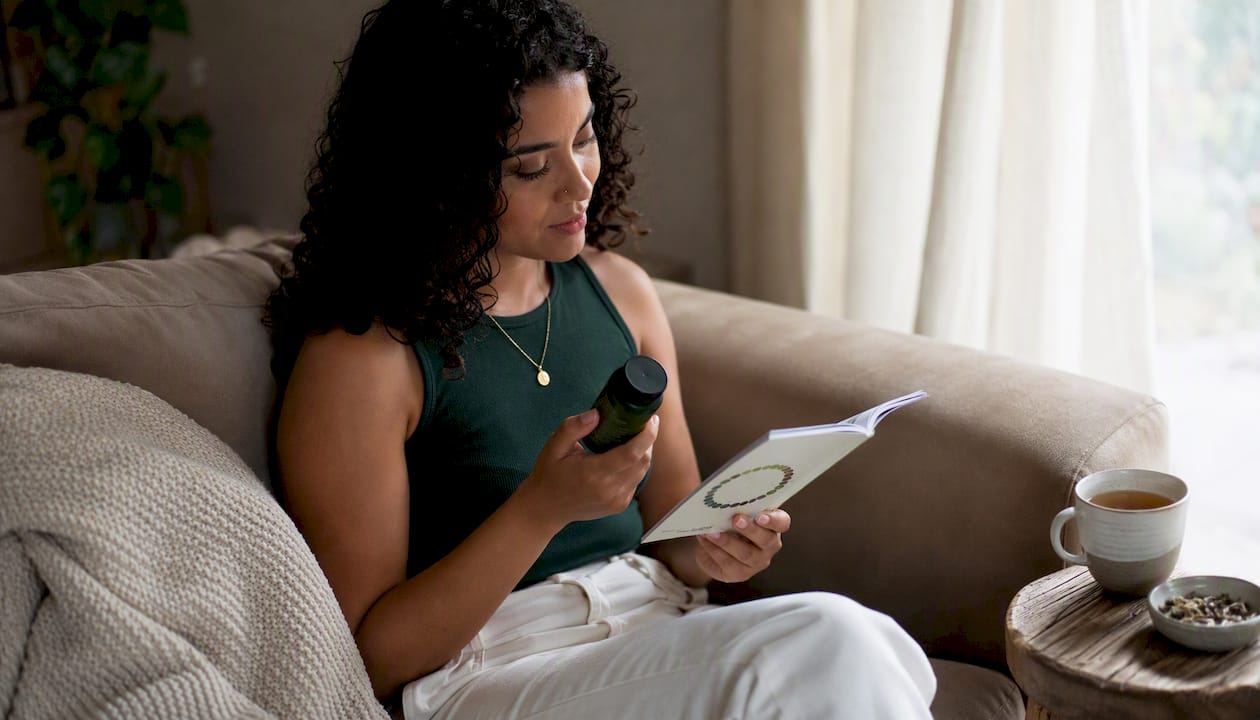
Tracking your menstrual cycle lets you identify patterns in pain, mood, and energy that can often be managed with lifestyle adjustments. The key is consistent daily entries rather than perfect ones.
Daily entry template
Log these fields each morning or evening, whichever you will actually do:
- Cycle day and bleeding (none / spotting / light / medium / heavy)
- Pain score 0–10
- Mood (one word or emoji is fine)
- Energy (low / medium / high)
- Appetite or cravings
- Sleep quality and hours
- Bowel pattern
- Topical or herbal actions taken
- Breathwork performed (yes / no, duration)
- Any acute events (illness, travel, stress)
Sample tracking table
| Date | Cycle day | Bleeding | Pain (0–10) | Mood | Energy | Sleep (hrs) | Herbal/topical | Breathwork |
|---|---|---|---|---|---|---|---|---|
| 1 June | 3 | Medium | 5 | Low | Low | — | Poke root oil massage | 5 min box breathing |
| 2 June | 4 | Light | 3 | Neutral | Medium | 7 | Herbal tea | 5 min 4-7-8 |
Holistic wellness guides recommend consistent data collection over time, whether via a journal or a wearable. Three full cycles give you reliable pattern detection; you can draw interim insights within 30 days.
Which holistic tools work best in each cycle phase?
Mapping interventions to phases means you test targeted support rather than scattering effort randomly. Here is a practical phase chart that outlines common patterns for each cycle phase with suggested goals and tools.
Movement such as walking or yoga produces consistent benefits for cortisol regulation and mood. In the follicular phase, that translates to 20–30 minutes of brisk walking or light rebounding to support lymphatic flow. In the luteal phase, swap intensity for restorative yoga and targeted breathwork.
Short daily breathing practices have been linked to meaningful cortisol reductions. Around ovulation, try 4–7–8 breathing (inhale four counts, hold seven, exhale eight) for five minutes. On bleed days, box breathing (four counts each side) is gentler and easier to sustain.
For topical use, apply castor oil or poke root oil to the lower abdomen or lymph node areas several times per week during the luteal phase, when inflammation tends to be higher. See the herbal lymph massage guide for step-by-step technique.
Pro Tip: Introduce only one new intervention per cycle phase. That way, when your tracking data shows a change, you know exactly what caused it.
How do you use herbs, teas, and topical oils safely in the UK?
Dosing logic for simple preparations is straightforward. For herbal infusions, steep one teaspoon of dried herb per cup of boiling water for 10–15 minutes. For decoctions (roots and bark), simmer for 20 minutes. For topical oils, apply a small amount to clean skin and massage in circular motions.
Getgutted describes its poke root oil as handcrafted in small batches, infused into organic castor oil, with ingredient purity and batch labelling as standard. Castor oil acts as the carrier, supporting absorption and adding its own anti-inflammatory properties. For practical herbal preparation guidance, the Getgutted blog covers dosing and sourcing in detail.
Safety first: Always patch-test a new topical oil on a small area of skin 24 hours before full application. Store dried herbs in airtight containers away from direct light and heat. Discard preparations that smell rancid or show discolouration.
Contraindications and safety checklist:
- Pregnancy: Do not use poke root preparations internally or topically during pregnancy. Consult your midwife or GP before using any botanical.
- Hormonal contraception: Some botanicals may interact with hormonal contraceptives. Speak to your GP or pharmacist before adding herbal teas or supplements.
- Prescription medications: Disclose all herbal use to your prescribing clinician. The MHRA regulates herbal medicines in the UK; look for the Traditional Herbal Registration (THR) mark on products where available.
- Topical sensitivity: Discontinue use immediately if you experience redness, itching, or swelling.
This article is general information, not medical advice. Confirm current guidance with your GP or a qualified herbalist for your specific situation.
Your 30-day starter plan, week by week
The principle here is one small, consistent daily practice for 30 days before layering anything else. Holistic resources consistently support this single-habit approach for gauging baseline change.
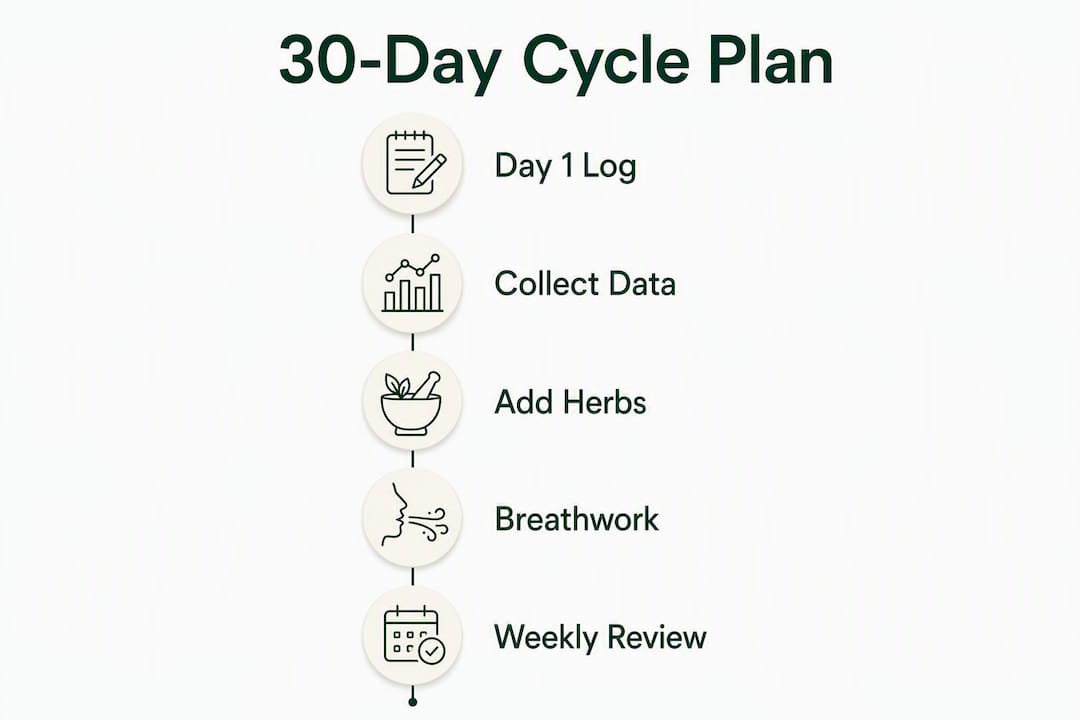
- Week 1 — Track only. Log your daily entry every morning. No new herbal or movement habit yet. Establish the baseline.
- Week 2 — Add breathwork. Five minutes of box breathing or 4–7–8 each morning. Continue daily log. Note any change in sleep or stress score. Stress reduction exercises can anchor this habit quickly.
- Week 3 — Add one herbal tea. Choose a preparation suited to your current phase (warming tea on bleed days, lighter infusion in follicular). Log the preparation and any symptom changes.
- Week 4 — Add topical oil. Introduce castor oil or poke root oil massage two to three times this week. Log application days and note any change in pain score or bloating.
At day 30, ask yourself:
- Has my average pain score dropped by two or more points?
- Am I sleeping better on most nights?
- Have I had fewer bloating days?
- Do I feel more aware of my cycle phases?
If yes to two or more: keep the habit and consider adding the next layer in cycle two. If no change: adapt the preparation or timing before stopping entirely. If symptoms worsened: stop and consult a clinician.
Avoid introducing two new habits in the same week. Confounding variables make it impossible to attribute any change accurately.
When should you see a clinician?
Cycle tracking supports self-care, but severe or disabling symptoms require gynaecological review, not a herbal protocol.
Red flags requiring prompt clinical attention:
- Pain scoring 8 or above that does not respond to standard pain relief
- Bleeding so heavy it soaks through a pad or tampon in under an hour
- Cycles shorter than 21 days or longer than 35 days, consistently
- Sudden systemic symptoms (fever, severe fatigue, unexplained weight change)
- Any new or worsening symptoms after starting a botanical preparation
Disclose all herbal use to your GP or pharmacist, particularly if you take anticoagulants, antidepressants, or hormonal contraception. The MHRA’s THR scheme provides a baseline assurance of quality for registered herbal products in the UK; products without that mark carry more uncertainty.
How do you measure progress and adapt across cycles?
Meaningful biological change from lifestyle interventions typically takes 8–12 weeks. That is three full cycles for most people. Set realistic expectations from the start.
- No change after one cycle: Check consistency first. Did you log every day? Did you apply the topical oil as planned? Inconsistent application is the most common reason for a null result.
- Small change (pain drops 1 point, sleep improves slightly): Hold the current protocol for another cycle before adding anything new.
- Meaningful improvement (pain drops 2+ points, fewer bloating days, better mood scores): Keep the habit. Add one new element in cycle three.
- Worsening: Stop the most recently introduced preparation and consult a clinician.
For irregular cycles, normalise the expectation that phase boundaries will shift. NHS natural family planning guidance is clear that app predictions are statistical, not definitive. Cross-check predicted phases with physical signs: cervical mucus texture and basal body temperature give you real-time confirmation that an algorithm cannot.
Pro Tip: Before applying phase-targeted botanicals, confirm the phase with at least one physical sign. An app that says “luteal” while your BBT is still low means you are probably still in the follicular phase.
About the author and how Getgutted fits this routine
Mabel writes the Getgutted blog with a focus on herbal wellness, lymphatic support, and practical natural remedies. Her posts cover topics from lymphatic support and natural remedies to why herbal remedies support hormone balance, building a body of educational content grounded in traditional herbal practice.
Getgutted’s poke root oil is infused into organic castor oil, handcrafted in small batches, and formulated specifically for topical lymphatic and hormonal support. It maps directly to the luteal-phase topical step in the 30-day plan above.
Getgutted wellness kits are designed for exactly this kind of starter routine: they include herbal teas, topical oils, and simple guidance so you are not sourcing five separate products from five separate suppliers. UK shipping is available, and the small-batch model means you receive a fresh preparation rather than a bulk-produced one sitting in a warehouse.
What Getgutted products cover in this plan:
- Herbal teas for weeks 3 and 4 of the starter plan
- Poke root oil for the week-4 topical step
- Wild-harvested botanicals with clear ingredient labelling
- Educational blog content to support each phase of your tracking
Key takeaways
Tracking your menstrual cycle with herbal and breathwork tools works best when you introduce one habit at a time, log daily, and review after three full cycles.
| Point | Details |
|---|---|
| Start with a daily log | Record cycle day, pain, mood, energy, and sleep every day before adding any herbal habit. |
| One habit per week | Introduce breathwork in week 2, herbal tea in week 3, topical oil in week 4 to isolate what works. |
| Review at day 30 | A pain drop of 2+ points or fewer bloating days signals the habit is worth keeping. |
| Allow 8–12 weeks for full change | Meaningful biological shifts take 8–12 weeks; interim signals are visible within 30 days. |
| Getgutted starter kits | Getgutted wellness kits include poke root oil and herbal teas that map directly to the 30-day plan. |
The case for treating this as an experiment, not a prescription
There is a tendency in herbal wellness circles to present cycle-syncing protocols as near-certain remedies. The honest framing is different: you are running a small, personal experiment with a sample size of one. That is not a weakness. It is actually the most useful kind of data you can collect, because it is specific to your body, your baseline, and your life circumstances.
What I find most valuable about pairing tracking with traditional botanicals is the discipline it creates. When you commit to logging daily and introducing one preparation at a time, you stop guessing and start observing. The poke root oil either changes your luteal pain score or it does not. The breathwork either improves your sleep log or it does not. That clarity is worth more than any generalised claim about what herbs “should” do.
Treat the 30-day plan as a structured curiosity. Be patient with the data. The body rarely changes in a straight line.
Getgutted wellness kits: ready for your first cycle
Readers who want a ready-assembled starter kit rather than sourcing individual preparations will find Getgutted’s wellness kits a practical fit for the plan above. Each kit includes poke root oil infused in organic castor oil, herbal teas suited to cycle-phase support, and clear usage guidance. UK shipping is standard, and the small-batch production model means ingredient freshness is built in rather than an afterthought.
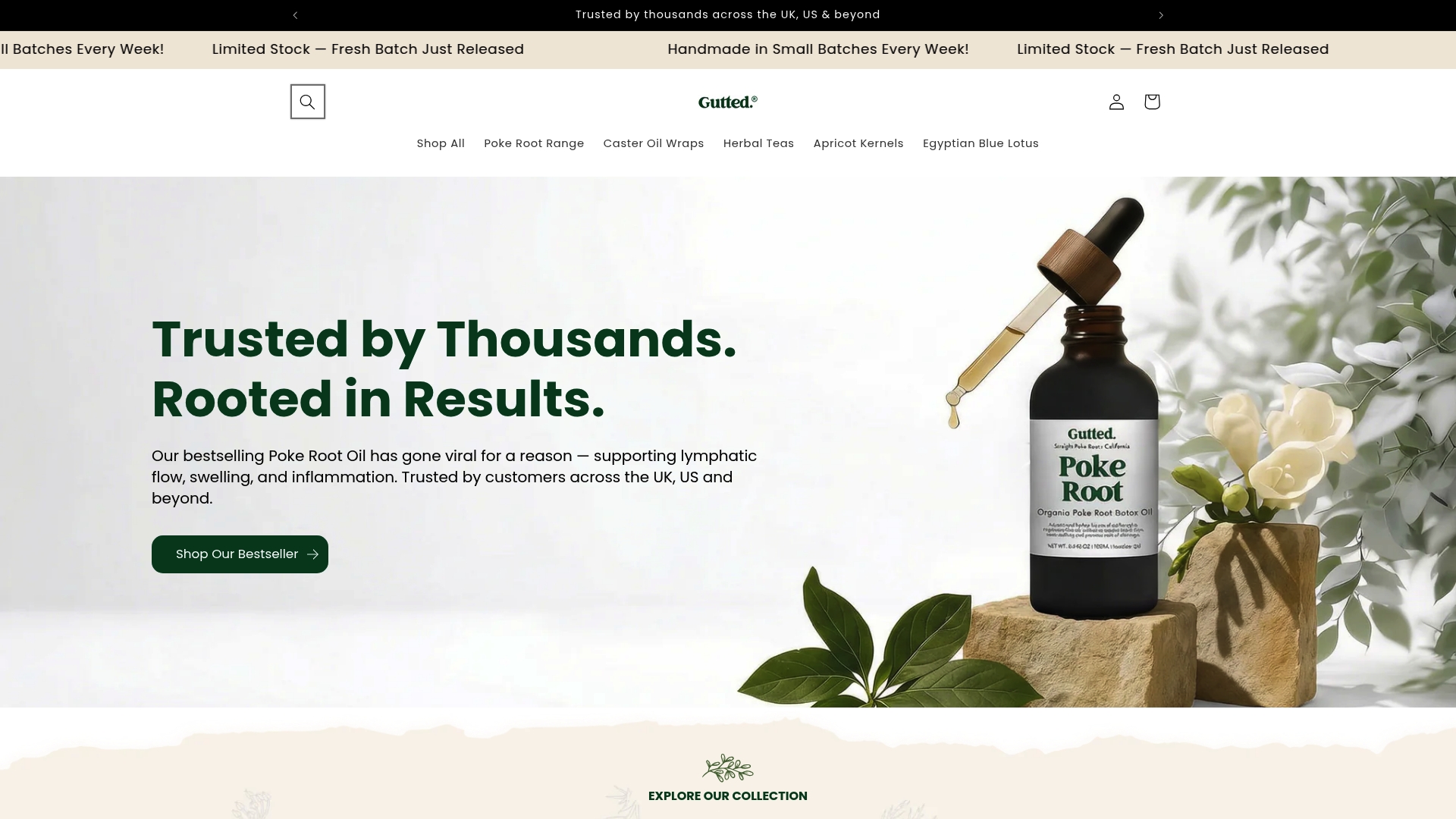
The kits are designed for exactly the kind of incremental, one-habit-at-a-time approach this plan describes. You get everything needed for weeks 2 through 4 in a single order, without the faff of assembling five separate products. View the current kit range at Getgutted and check availability for your cycle start date.
Note: if you are pregnant or taking prescription medication, consult your GP or pharmacist before ordering any herbal preparation.
Useful sources
- A beginner’s guide to tracking your menstrual cycle — UPMC HealthBeat: practical guidance on daily symptom logging and when to seek clinical review.
- Natural family planning — NHS: authoritative UK guidance on cross-checking app predictions with physical signs.
- The 5 pillars of longevity — Harvard Health: evidence base for movement, sleep, and stress management as hormonal wellness pillars.
- Create a holistic wellness routine — Acroan: habit formation timelines and breathwork evidence for daily routines.
- Lymphatic support: natural remedies and evidence — Getgutted: how lifestyle and complementary practices reduce cycle-related inflammation.
- Herbal remedies for bodily wellness: a practical guide — Getgutted: preparation, dosing, and sourcing guidance for herbal infusions and topical oils.
- Design a lymphatic support wellness programme — Getgutted: phased wellness programme structure pairing movement with topical therapies.