

Herbal inflammation research explained: 2026 guide
Herbal inflammation research is the scientific study of plant-derived bioactive compounds that reduce the body’s inflammatory response through multiple molecular pathways. Unlike pharmaceutical drugs, which typically block a single target, plant compounds such as quercetin, kaempferol, and celastrol act on several signalling networks at once. This multi-target action is what makes herbal anti-inflammatories a growing focus for researchers worldwide. Recent advances in delivery technology and clinical trials have moved this field well beyond folk medicine, giving people seeking natural anti-inflammatory methods a far stronger evidence base to draw from.
What does herbal inflammation research actually cover?
Herbal inflammation research examines how bioactive plant compounds modulate the body’s inflammatory response at the cellular and molecular level. The field sits at the crossroads of pharmacognosy, immunology, and clinical nutrition. Researchers study everything from isolated flavonoids to whole-plant extracts, measuring their effects on inflammatory markers such as TNF-α, IL-1β, and IL-6.

The key distinction from conventional pharmacology is mechanism breadth. Natural products act on complex signalling networks simultaneously, whereas most pharmaceutical drugs hit a single receptor or enzyme. That breadth is both the promise and the complication of this field: broader action means fewer blind spots, but it also makes standardisation harder.
Regulatory bodies including the European Medicines Agency and the World Health Organisation have published monographs on dozens of medicinal plants, lending formal credibility to the research. The field now includes preclinical laboratory studies, animal models, and an increasing number of randomised controlled trials.
What are the main herbal compounds studied for anti-inflammatory effects?
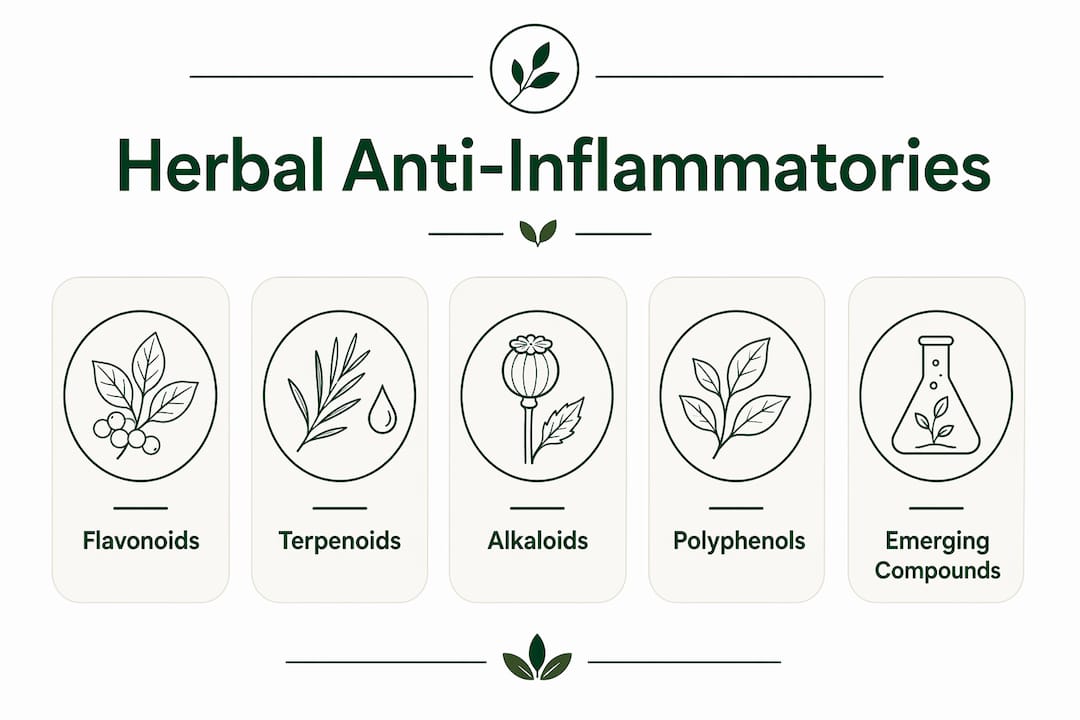
Three major classes of plant compounds dominate the research on natural anti-inflammatory herbs: flavonoids, terpenoids, and alkaloids. Each class contains distinct molecules with well-documented effects on inflammation.
Flavonoids
Flavonoids are the most extensively studied group. Quercetin, found in onions, capers, and apples, suppresses pro-inflammatory cytokine production and inhibits the NF-κB signalling pathway. Kaempferol, present in kale and broccoli, reduces neuroinflammation by regulating microglia and lowering TNF-α and IL-1β levels in preclinical models. Kaempferol and acteoside show effective inhibition of multiple inflammatory mediators across several signalling pathways. These are not marginal effects; they are reproducible across dozens of independent laboratory studies.
Terpenoids and alkaloids
Celastrol, a terpenoid extracted from the Thunder God Vine (Tripterygium wilfordii), targets the NLRP3 inflammasome, a protein complex central to chronic inflammatory disease. Alkaloids such as berberine, found in goldenseal and barberry, inhibit both COX enzymes and the MAPK pathway. Traditional Ayurvedic and Chinese medicine used these plants for centuries before researchers identified the specific molecules responsible for their effects.
- Quercetin: Inhibits NF-κB; reduces intrahepatic lipid accumulation in clinical trials
- Kaempferol: Suppresses TNF-α and IL-1β; active in neuroinflammation models
- Celastrol: Targets NLRP3 inflammasome; reduces systemic chronic inflammation
- Berberine: Inhibits COX and MAPK pathways; broad anti-inflammatory activity
- Cordycepin: Derived from Cordyceps fungi; blocks NLRP3 activation at the priming stage
Pro Tip: When reading herbal supplement labels, look for the specific bioactive compound and its concentration rather than just the plant name. “Quercetin 500 mg” tells you far more than “onion extract.”
How do herbal compounds reduce inflammation at the molecular level?
Herbal compounds reduce inflammation by interrupting the signalling cascades that trigger and sustain it. The four most studied pathways are NF-κB, COX, MAPK, and the NLRP3 inflammasome.
NF-κB and COX inhibition
NF-κB is a transcription factor that switches on genes for pro-inflammatory cytokines. When plant compounds block NF-κB activation, they reduce the production of TNF-α, IL-1β, and IL-6 upstream, before these cytokines cause tissue damage. COX inhibition works differently: it blocks the enzyme that converts arachidonic acid into prostaglandins, the same mechanism used by ibuprofen. Phytochemicals inhibit NF-κB, COX, and LOX pathways simultaneously, which is something no single NSAID achieves.
The NLRP3 inflammasome
The NLRP3 inflammasome is a protein complex that acts as an alarm system inside immune cells. When activated, it triggers the release of IL-1β and IL-18, two cytokines strongly linked to chronic inflammatory conditions including gout, type 2 diabetes, and atherosclerosis. Quercetin, celastrol, and cordycepin inhibit NLRP3 at both the priming and activation stages. This dual-stage blockade is more thorough than blocking the inflammasome at only one point.
| Pathway | Key herbal inhibitors | Cytokines affected |
|---|---|---|
| NF-κB | Quercetin, berberine, curcumin | TNF-α, IL-1β, IL-6 |
| COX-1/COX-2 | Kaempferol, boswellic acids | Prostaglandins |
| MAPK | Berberine, celastrol | IL-6, TNF-α |
| NLRP3 inflammasome | Quercetin, celastrol, cordycepin | IL-1β, IL-18 |
Flavonoids and polyphenols suppress the LPS-TLR4-NF-κB axis to lower NLRP3 and pro-IL-1β transcription. This means they act before the inflammasome even assembles, not just after it fires. That upstream action is a key advantage over many pharmaceutical agents, which intervene only at the cytokine level.
What are the recent advances in herbal anti-inflammatory research?
The most significant recent advance is not a new compound but a new way of delivering existing ones. Bioavailability has long been the bottleneck for herbal anti-inflammatories. Many flavonoids are poorly absorbed in the gut, which limits their clinical effect regardless of how potent they are in a test tube.
Phytosome and nanotechnology delivery
Phytosomes are phospholipid complexes that bind plant compounds and dramatically improve their absorption through the gut wall. Advanced delivery systems like phytosomes increase the oral bioavailability of flavonoids by up to 20-fold. That is not a marginal improvement; it changes the clinical calculus entirely. A compound that was previously sub-therapeutic at standard doses can become genuinely effective when delivered via a phytosome.
Clinical data backs this up. Quercetin supplementation reduced intrahepatic lipid accumulation in people with non-alcoholic fatty liver disease from 11.5% to 9.6%. Liver fat reduction of that magnitude, achieved with a plant compound, signals real therapeutic potential. You can read more about how these advances connect to herbal products for inflammation and lymphatic health.
Emerging compounds and clinical challenges
Cordycepin, derived from Cordyceps fungi, has emerged as a promising NLRP3 inhibitor with antiviral properties studied in the context of COVID-19 viral clearance. Celastrol continues to attract attention for its potency against systemic chronic inflammation. Clinical evidence remains promising but lacks large-scale trials, and standardisation of dosing regimens is still an open problem. Researchers are calling for rigorous randomised controlled trials before any of these compounds can be considered mainstream therapy.
How can you safely incorporate herbal anti-inflammatory remedies?
Herbal remedies for inflammation work best as a long-term, complementary strategy rather than an immediate fix. Herbal treatments suit chronic, low-grade systemic inflammation but are less effective for acute pain where NSAIDs offer faster relief. If you have a sudden injury or a severe flare, reach for evidence-based acute care first.
For chronic inflammation management, a structured approach works best:
- Identify your goal. Are you managing joint stiffness, gut inflammation, or systemic low-grade inflammation? Different compounds target different tissues.
- Choose quality products. Look for standardised extracts with verified bioactive concentrations. Unstandardised products vary wildly in potency.
- Start with one compound. Introduce quercetin, kaempferol, or a curcumin phytosome individually so you can assess your response clearly.
- Allow adequate time. Herbal anti-inflammatories require consistent use over weeks to months. Expect gradual improvement, not overnight relief.
- Consult a healthcare professional. Patients should not self-replace NSAIDs with herbal remedies for acute pain without professional guidance, particularly if they take anticoagulants or immunosuppressants.
Clinical translation of herbs like Devil’s Claw is currently limited by small sample sizes and formulation heterogeneity. This means you should treat herbal remedies as complementary support, not as a replacement for prescribed medication. The top herbs for holistic wellness resource from Getgutted offers a practical starting point for understanding which plants have the strongest evidence base.
Pro Tip: If you take blood thinners such as warfarin, speak to your GP before adding quercetin or high-dose turmeric. Both compounds can affect platelet aggregation and may alter how your medication works.
Key takeaways
Herbal anti-inflammatory compounds work through multi-pathway mechanisms that target inflammation at the molecular level, making them genuinely useful complements to conventional care when used consistently and correctly.
| Point | Details |
|---|---|
| Multi-target action | Plant compounds block NF-κB, COX, MAPK, and NLRP3 simultaneously, unlike single-target NSAIDs. |
| Bioavailability matters | Phytosome delivery systems increase flavonoid absorption by up to 20-fold, making dosing far more effective. |
| Best for chronic inflammation | Herbal remedies suit long-term, low-grade inflammation management rather than acute pain relief. |
| Clinical evidence is growing | Quercetin reduced liver fat in NAFLD patients, but large-scale trials are still needed across most compounds. |
| Professional guidance is non-negotiable | Always consult a healthcare professional before replacing prescribed medication with herbal alternatives. |
Why I think herbal inflammation research deserves more serious attention
I have followed plant-based medicine for years, and the honest truth is that the science has moved faster than public perception. Most people still think of herbal remedies as either folk wisdom or marketing. Neither framing is accurate anymore.
The NLRP3 inflammasome research is the area I find most compelling. The fact that quercetin blocks inflammasome assembly at two separate stages, not just one, is the kind of mechanistic specificity that used to be reserved for pharmaceutical patents. That is not anecdote; it is reproducible biochemistry.
Where I urge caution is on the clinical side. Preclinical data is not clinical data. A compound that reduces IL-1β in a mouse model may behave very differently in a person with comorbidities and a complex medication list. The lack of large-scale randomised trials is a genuine limitation, not a technicality. Until we have those trials, herbal anti-inflammatories belong in the “complementary” column, not the “replacement” column.
The future I would like to see is one where phytosome-delivered quercetin or celastrol is tested in properly powered trials alongside standard care for conditions like gout or inflammatory bowel disease. The delivery technology now exists. The compounds are promising. What is missing is the institutional will to fund the trials. That gap is narrowing, and I think the next five years will produce findings that shift clinical guidelines meaningfully.
— Mabel
Supporting your inflammatory health with Getgutted
Getgutted formulates its products around the same plant compounds that researchers are studying most closely. The herbal teas collection includes botanicals with documented anti-inflammatory properties, designed for consistent daily use rather than one-off supplementation. For a broader approach, the wellness kits combine herbal oils, teas, and supporting products to address inflammation and lymphatic health together. Every product is small-batch and made to strict ingredient standards. Use them alongside professional medical advice, not in place of it, and give them the weeks of consistent use the research shows they need to work.
FAQ
What is herbal inflammation research?
Herbal inflammation research is the scientific study of plant-derived compounds that reduce the body’s inflammatory response. It examines how bioactives like quercetin, kaempferol, and celastrol modulate molecular pathways including NF-κB, COX, and the NLRP3 inflammasome.
How do herbs reduce inflammation differently from ibuprofen?
Ibuprofen blocks a single enzyme (COX), while herbal compounds act on multiple signalling pathways simultaneously. This multi-target action can address inflammation more broadly, though it works more slowly than NSAIDs for acute pain.
Are herbal anti-inflammatories safe to use long-term?
Most well-studied compounds such as quercetin and curcumin have good safety profiles at standard doses, but long-term use should be discussed with a healthcare professional, particularly if you take prescription medication.
Which herbal compounds have the strongest clinical evidence?
Quercetin has clinical evidence showing reduced liver fat in NAFLD patients. Curcumin phytosomes have demonstrated anti-inflammatory effects in joint health trials. Both benefit significantly from advanced delivery systems that improve absorption.
Can herbal remedies replace NSAIDs for acute inflammation?
No. Herbal remedies are less effective for acute pain where NSAIDs provide faster relief. They are best used as a long-term complementary strategy for chronic, low-grade systemic inflammation.