

How to document herbal wellness client outcomes: a UK practitioner's guide
Documenting herbal wellness client outcomes rigorously is the difference between anecdote and evidence. The most effective approach combines longitudinal tracking with validated patient-reported tools, objective clinical measures, and adherence to recognised UK reporting frameworks. At its core, this means using instruments like MYMOP2 across multiple consultations, applying the elaborated CONSORT Statement for any trial-based work, and aligning records with NICE guidelines and British Herbal Medicine Association (BHMA) standards. Legal compliance under UK GDPR adds a further layer: personal identifiers must be kept separate from clinical outcome data from the outset.
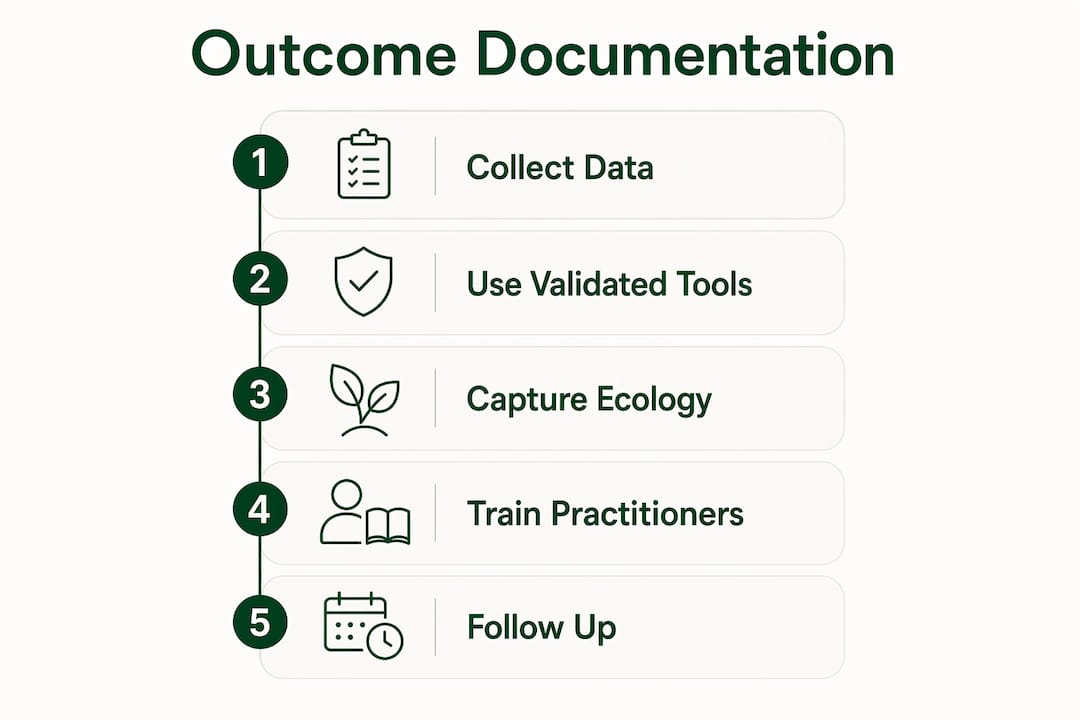
The core elements of a sound documentation system include:
- Validated subjective tools: MYMOP2 for patient-reported symptom and wellbeing scores across visits
- Objective clinical measures: blood pressure, inflammatory markers, hormonal panels where clinically indicated
- Holistic patient ecology data: sleep quality, energy levels, mood, and lifestyle factors documented alongside herbal treatment
- Reporting framework adherence: CONSORT for trial reporting, BHMA standards for product and practitioner documentation, NICE guidelines for clinical integration
- Longitudinal structure: repeated assessments over three or more consultations to distinguish treatment effect from natural symptom fluctuation
- Legal and ethical compliance: GDPR-compliant record separation, informed consent, and data confidentiality protocols
Table of Contents
- How study design and validated outcome measures shape herbal medicine research
- What reporting guidelines and quality standards apply to herbal wellness outcomes?
- Why capturing patient ecology makes your outcome records more accurate
- What wellness goals and outcomes do practitioners most commonly document?
- What training and competency do practitioners need to document outcomes well?
- What are the main challenges in measuring herbal outcomes in the UK?
- How should you structure longitudinal follow-up to monitor herbal outcomes reliably?
- Supporting your practice with the right tools
- Key takeaways
How study design and validated outcome measures shape herbal medicine research
The choice of study design determines how credible your outcome data will be. Randomised controlled trials (RCTs) remain the gold standard for establishing causation in herbal medicine, but pragmatic trials and prospective audits are often more realistic in clinical practice settings. A prospective audit using MYMOP2, for instance, can generate statistically significant outcome data without the resource demands of a full RCT, making it accessible to individual practitioners or small clinics.
Outcome measures in herbal medicine fall into two broad categories: subjective and objective. Subjective measures capture the patient’s own experience, which is frequently the most clinically meaningful signal in herbal practice. MYMOP2 (Measure Yourself Medical Outcome Profile, version 2) is the most widely validated tool for this purpose. It asks patients to identify their own priority symptoms and rate them on a numerical scale at each visit, producing a profile score that tracks change over time. Objective measures, by contrast, include laboratory values, physical examination findings, and standardised clinical assessments.
| Measure type | Examples | Strengths | Limitations |
|---|---|---|---|
| Subjective (patient-reported) | MYMOP2, VAS pain scale | Captures individual experience; sensitive to meaningful change | Susceptible to placebo effect and recall bias |
| Objective (clinician-assessed) | Blood pressure, CRP, hormone panels | Reproducible; externally verifiable | May miss patient-relevant functional changes |
| Mixed | MYMOP2 combined with biomarkers | Comprehensive picture of treatment response | Requires more practitioner time and resources |
Best practices for study design and outcome validity in herbal interventions:
- Define primary and secondary outcomes before data collection begins, not after
- Use MYMOP2 at every consultation rather than selectively, to avoid cherry-picking favourable data points
- Record baseline measures at the first visit before any treatment is administered
- Account for concomitant treatments, lifestyle changes, and seasonal variation in your analysis
- Apply appropriate statistical tests; improvements in MYMOP2 scores reaching P < 0.001 have been demonstrated in UK herbal practice audits, but smaller samples require careful interpretation
- Pre-register prospective audits where possible to strengthen credibility
What reporting guidelines and quality standards apply to herbal wellness outcomes?
The elaborated CONSORT Statement for herbal randomised controlled trials is the most authoritative reporting framework available to practitioners and researchers. Standard CONSORT was designed for pharmaceutical trials and does not address the complexities specific to herbal medicine, such as variability in plant material, preparation methods, and the challenge of blinding. The elaborated version adds extension items covering the botanical identity of the herb, the preparation used, the dose rationale, and the quality control measures applied to the product. Any practitioner publishing trial data or audit results should apply these extensions as a minimum.
BHMA standards provide the quality assurance backbone for day-to-day practice. The BHMA publishes detailed protocols covering good manufacturing practices for herbal products and documentation requirements for practitioners, including how to record product provenance, batch information, and preparation method in clinical notes. This matters because outcome data is only interpretable if the treatment itself is consistently described. A result attributed to “valerian” means very little without knowing whether it was a standardised extract, a dried root preparation, or a tincture at a specific concentration.
NICE guidelines shape how herbal medicine outcomes are reported and interpreted within the broader NHS and integrated care context. Where NICE has issued guidance touching on complementary therapies, practitioners need to frame their outcome documentation in terms that align with NICE’s evidence standards, particularly when making referrals or communicating with GP colleagues.
Key documentation requirements for transparent, reproducible herbal outcome records:
- Full botanical identification of each herb used, including Latin binomial and plant part
- Preparation type, extraction method, and dose at each consultation
- Product batch number or supplier reference for quality traceability
- MYMOP2 or equivalent validated score at each visit, with date
- Any adverse events, however minor, recorded systematically
- Concomitant medications and supplements noted at every review
Why capturing patient ecology makes your outcome records more accurate
Focusing solely on a named symptom or disease label misses the most clinically useful information in herbal practice. A patient’s ecology, meaning their energy levels, sleep architecture, mood, digestive function, and daily lifestyle patterns, often shifts before the primary complaint resolves. Documenting these changes gives you a richer, more accurate picture of what the treatment is actually doing.
Lifestyle modifications run alongside herbal treatments in almost every clinical case. A patient who simultaneously improves their sleep hygiene, reduces alcohol intake, and starts a daily walk will show outcome improvements that cannot be attributed to the herb alone. Documenting the full treatment package, including every lifestyle recommendation made and the patient’s reported adherence, prevents misattributed effect assessment and strengthens the clinical record. This is especially relevant when combining multiple wellness modalities within a single treatment plan.
Practical data capture elements for clinical notes:
- Energy levels rated on a simple numerical scale (1–10) at each visit
- Sleep quality: hours, continuity, and subjective restfulness
- Mood and stress levels, using patient’s own descriptors or a validated scale
- Dietary changes made during the treatment period
- Physical activity level and any changes from baseline
- Adherence to the herbal prescription, including missed doses or self-modifications
Pro Tip: Use a brief structured template at the start of each follow-up consultation rather than relying on free-text notes. A consistent format across visits makes longitudinal comparison far easier and reduces the risk of missing a clinically significant change in patient ecology.
What wellness goals and outcomes do practitioners most commonly document?
The most frequently documented goals in herbal practice cluster around symptom relief, functional improvement, and subjective wellbeing. Common targets include menstrual symptom reduction, improved sleep quality, reduced inflammatory pain, hormonal balance, digestive comfort, and energy restoration. These align closely with the conditions for which patients most often seek herbal treatment in the UK.
Patient-reported outcome data from UK herbal practice is more compelling than many practitioners realise. In a UK study of gynaecological herbal treatment, 82.2% of patients reported perceived therapeutic benefit, with 98.1% reporting no adverse events or only minor ones. MYMOP2 scores showed statistically significant improvement (P < 0.001). These figures are not outliers; they reflect what well-documented, practitioner-led herbal care can produce when outcomes are tracked systematically.
82.2% of patients in a UK gynaecological herbal treatment study reported perceived therapeutic benefit, with statistically significant MYMOP2 score improvements at P < 0.001.
Patient-centred success definitions often diverge from biomarker-based endpoints. A patient may report feeling “well” before their CRP levels normalise, or may prioritise sleep quality over pain scores. Aligning your documentation with what the patient themselves identifies as a meaningful improvement, which is precisely what MYMOP2 is designed to capture, produces outcome records that reflect real clinical value. Practitioners working with herbal detox and balance protocols will recognise this pattern: clients often report improved energy and mood weeks before any measurable biochemical shift.
Wellness goals by domain, as commonly documented in UK herbal practice:
- Musculoskeletal: joint pain reduction, improved mobility, reduced morning stiffness
- Gynaecological: menstrual pain relief, cycle regularity, reduced PMS severity
- Neurological/psychological: improved sleep onset and quality, reduced anxiety, better stress resilience
- Digestive: reduced bloating, improved bowel regularity, relief from IBS-type symptoms
- Metabolic/endocrine: improved energy, hormonal balance markers, weight management support
- Immune: reduced frequency of infections, faster recovery, reduced allergic response
What training and competency do practitioners need to document outcomes well?
Outcome documentation is a clinical skill, not an administrative task. Practitioners who lack training in validated measurement tools tend to rely on free-text narrative notes, which are difficult to analyse, impossible to aggregate across a caseload, and unconvincing to commissioners or researchers. Formal training in tools like MYMOP2, including how to administer it consistently and how to interpret profile scores, is a prerequisite for credible outcome tracking.
Professional registration bodies in the UK, including the National Institute of Medical Herbalists (NIMH) and the College of Practitioners of Phytotherapy (CPP), set competency standards that include clinical record-keeping. Continuing professional development in research literacy, specifically understanding study design, statistical significance, and reporting frameworks like CONSORT, equips practitioners to move beyond anecdotal case notes towards systematic outcome evaluation. The ACORN School of Herbal Medicine provides clinical training that integrates outcome documentation into supervised practice from an early stage.

Electronic health record (EHR) systems designed for complementary medicine practitioners can support consistent documentation, but only if the practitioner understands what data to collect and why. Training should cover not just how to use the software but how to structure clinical entries so that outcome data is retrievable, comparable across visits, and exportable for audit purposes. Practitioners who track progress systematically across their caseload are better positioned to identify patterns, refine prescribing, and contribute to the broader evidence base for herbal medicine.
What are the main challenges in measuring herbal outcomes in the UK?
Attribution is the hardest problem in herbal outcome measurement. Patients rarely take a single herb in isolation; they receive a complex prescription, alongside lifestyle advice, within a therapeutic relationship that itself has measurable effects. Separating the herb’s contribution from these confounding factors requires careful study design and honest documentation, neither of which is straightforward in routine practice.
Standardisation of herbal products presents a persistent challenge. Unlike pharmaceutical drugs, herbal preparations vary in potency depending on plant provenance, harvest timing, extraction method, and storage conditions. Two practitioners using “the same” herb may be administering preparations with meaningfully different phytochemical profiles. Without detailed product documentation, outcome data from different practitioners or clinics cannot be meaningfully compared. The EMA’s non-clinical documentation guidelines for herbal medicinal products underscore how fundamental botanical and phytochemical characterisation is to any credible assessment.
Regulatory and funding constraints in the UK also limit the scale of herbal outcome research. NHS funding for herbal medicine research is limited, and most UK herbal practitioners work in private practice without access to the infrastructure that supports clinical trial conduct. Pragmatic audits and prospective case series remain the most feasible designs for most practitioners, but they carry inherent limitations around generalisability and bias. Patient adherence to herbal prescriptions is another variable that is frequently underdocumented; a patient who takes their prescription inconsistently will produce outcome data that underestimates the treatment’s potential effect.
How should you structure longitudinal follow-up to monitor herbal outcomes reliably?
Repeated assessment over time is what separates credible outcome documentation from a single favourable snapshot. Three or more MYMOP2 assessments across consecutive consultations provide the minimum data needed to distinguish a genuine treatment response from natural symptom fluctuation or regression to the mean. A single post-treatment score, however positive, cannot carry that evidential weight.
The follow-up schedule should match the condition’s natural history. Chronic conditions, such as hormonal imbalance or persistent inflammatory pain, require longer tracking periods than acute presentations. Patients using herbs for chronic conditions typically need at least three to six months of documented follow-up before a meaningful outcome picture emerges. Acute conditions may resolve or fail to respond within two to four weeks, making shorter, more frequent assessments appropriate. Practitioners incorporating botanical remedies into clinical workflows should build follow-up intervals into the initial treatment plan rather than scheduling them reactively.
Practical strategies for maintaining longitudinal outcome records:
- Set fixed review points at the first consultation (e.g., four weeks, eight weeks, twelve weeks) and record them in the patient’s notes
- Administer MYMOP2 at every scheduled review, not only when the patient reports a change
- Record any changes to the prescription between visits, with the clinical rationale, so that outcome shifts can be linked to specific treatment modifications
- Use a simple graph or table within the patient record to plot MYMOP2 profile scores over time; visual trends are easier to interpret and communicate than columns of numbers
- Flag cases where outcomes plateau or worsen for clinical review, rather than continuing unchanged prescriptions
Patient adherence tracking is a component that practitioners often overlook in longitudinal monitoring. Asking directly at each visit how consistently the patient has taken their prescription, and recording the answer, transforms adherence from an assumption into a documented variable. When outcomes are poor, this data tells you whether the prescription failed or whether it was never adequately trialled. Supplement adherence, particularly for portable or travel-friendly formats, can be meaningfully supported by practical adherence strategies that reduce the barriers patients face in maintaining consistent use.
Supporting your practice with the right tools
Getgutted’s wellness kits are designed for practitioners and health-conscious individuals who take a structured approach to herbal wellbeing. Each kit brings together botanically sourced, small-batch formulations that support the kinds of outcomes practitioners most commonly track: lymphatic drainage, inflammatory balance, hormonal support, and detoxification. When you are documenting client outcomes systematically, having a consistent, quality-assured product range removes one layer of variability from your records.
Key takeaways
Rigorous herbal wellness outcome documentation requires validated tools like MYMOP2, adherence to CONSORT and BHMA standards, GDPR-compliant record-keeping, and longitudinal follow-up across three or more consultations.
| Point | Details |
|---|---|
| Use MYMOP2 consistently | Administer at every consultation to build a longitudinal profile that distinguishes treatment effect from natural fluctuation. |
| Apply CONSORT extensions | The elaborated CONSORT Statement for herbal trials covers botanical identity, preparation, dose, and quality control, all mandatory for credible reporting. |
| Document the full treatment package | Record lifestyle changes and adherence alongside herbal prescriptions to prevent misattributed outcome assessment. |
| Separate personal and clinical data | UK GDPR requires personal identifiers to be kept distinct from clinical outcome records from initial intake. |
| Align goals with patient priorities | In a UK gynaecological study, 82.2% of patients reported therapeutic benefit when outcomes were measured against patient-defined priorities using MYMOP2. |