

Essiac tea explained: benefits and the 8 key herbs
TL;DR:
- Essiac tea originates from Ojibwa herbal traditions and was popularized in Canada in the 1920s.
- The eight-herb formula includes herbs for detoxification, immune support, and mineral balance.
- Scientific evidence supports antioxidant effects but lacks human clinical trials confirming health benefits.
Essiac tea is one of the most talked-about herbal blends in natural wellness circles, yet few people understand what it actually contains or where it came from. Originating from an Ojibwa formula, it was popularised in the 1920s by Canadian nurse Rene Caisse, whose surname spelled backwards gives the tea its name. Today, it appears in UK health shops and online stores as a detox and wellness supplement. This article breaks down the full eight-herb formula, what each herb does, how they work together, and what the science actually says, so you can make an informed choice.
Table of Contents
- Where does Essiac tea come from?
- The eight herbs in Essiac tea: what each one does
- Potential benefits and scientific evidence
- Is Essiac tea safe? Risks and UK guidelines
- A fresh take: what most wellness guides miss about Essiac tea
- Discover herbal detox support with Gutted
- Frequently asked questions
Key Takeaways
| Point | Details |
|---|---|
| Unique herbal history | Essiac tea’s roots span Native American tradition to modern wellness, blending eight powerful herbs. |
| Mixed scientific backing | Most health claims rely on tradition and lab studies, as human trials remain inconclusive. |
| Safety first | Consult a doctor before use, especially if pregnant or undergoing medical treatment. |
| Choose quality blends | Opt for reputable UK herbal supplement brands to ensure safety and authenticity. |
Where does Essiac tea come from?
Essiac tea has a history that spans continents and centuries. Its roots lie with the Ojibwa people of North America, who used a combination of wild herbs for cleansing and general wellbeing. The formula was passed to Rene Caisse, a Canadian nurse, in the 1920s, and she spent decades administering it to patients and refining the blend.
The original Ojibwa formula contained four core herbs. Caisse later collaborated with Dr Charles Brusch, a physician who had treated US presidents, and together they expanded the recipe. That expanded version, known as Flor Essence, includes eight herbs in total. You can read more about Flor Essence clinical details to understand how the formula was studied.
Here is a quick timeline of how the formula evolved:
- 1920s: Rene Caisse receives the Ojibwa formula and begins using it in Canada
- 1950s60s: Collaboration with Dr Brusch leads to the expanded eight-herb blend
- 1980s: Flor Essence is commercialised and made available to the public
- 1990s to present: Growing interest in the UK as part of herbal and herbal infusions and detox wellness routines
“The formula moved from a traditional indigenous remedy to a globally recognised herbal supplement over the course of roughly a century, shaped by both traditional knowledge and early integrative medicine.”
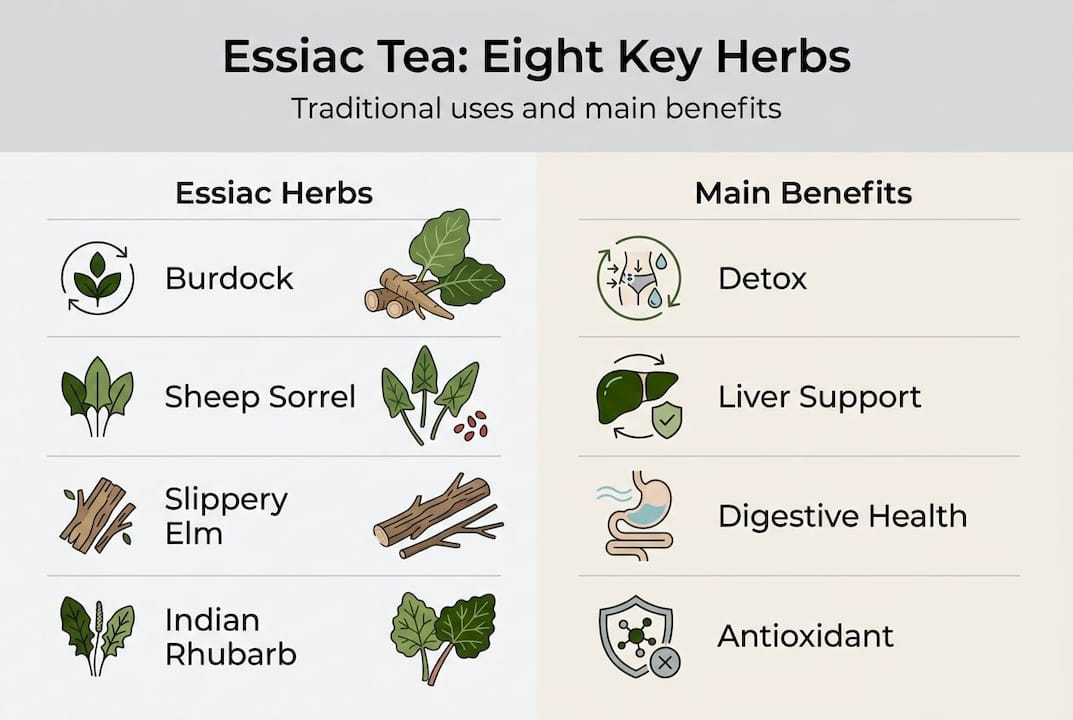
Today, two main versions exist. The four-herb original contains burdock root, sheep sorrel, slippery elm bark, and Indian rhubarb root. The eight-herb Flor Essence version adds watercress, blessed thistle, red clover, and kelp. Both are available in the UK as herbal supplements.
The eight herbs in Essiac tea: what each one does
Understanding the history sets the stage for a closer look at what goes into Essiac tea and why these specific herbs matter.
The four core herbs each bring a distinct function:
- Burdock root: Traditionally used for liver support, blood purification, and antioxidant activity. It is one of the most widely used cleansing herbs in European and Asian herbal traditions.
- Sheep sorrel: Used for its anti-inflammatory and detoxifying properties. It contains anthraquinones, compounds associated with cellular cleansing.
- Slippery elm bark: Known for soothing the digestive tract. It forms a gel-like coating in the gut, which may ease irritation and support bowel regularity.
- Turkey rhubarb root (Indian rhubarb root): Traditionally used as a gentle laxative and liver tonic. It supports the body’s natural elimination processes.
The expanded Flor Essence formula adds four more herbs:
- Watercress: Rich in vitamins and minerals, traditionally used to support circulation and cleansing via the kidneys.
- Blessed thistle: Historically used to stimulate digestion and support liver function. It is also associated with mild anti-inflammatory effects.
- Red clover: Contains isoflavones, plant compounds linked to immune support and hormonal balance. Traditionally used as a blood purifier.
- Kelp: A sea vegetable high in iodine, used to support thyroid function and general mineral balance.
| Herb | Traditional use | Key benefit area |
|---|---|---|
| Burdock root | Blood purification | Liver, antioxidant |
| Sheep sorrel | Cellular detox | Anti-inflammatory |
| Slippery elm bark | Gut soothing | Digestive health |
| Turkey rhubarb root | Elimination | Liver, cleansing |
| Watercress | Circulation | Kidney support |
| Blessed thistle | Digestion | Liver, inflammation |
| Red clover | Blood purifying | Immune support |
| Kelp | Mineral balance | Thyroid, cleansing |
Pro Tip: When choosing between the four-herb and eight-herb blends, consider your primary goal. If digestion and liver support are your focus, the original four herbs may be sufficient. If you want broader immune and mineral support, the eight-herb version offers more range. Explore herbal blends for detox and detox herbs to try for further guidance.
Potential benefits and scientific evidence
Now that you know what each herb brings to the formula, it is worth examining what the science actually says about Essiac tea as a whole.
The traditional claims are broad. Supporters point to detoxification, reduced inflammation, immune strengthening, and general wellness support. These claims are rooted in the individual properties of the herbs and centuries of traditional use.
The scientific picture is more nuanced. Lab and animal studies have shown antioxidant activity, DNA-protective effects, and some anti-proliferative effects on cancer cells in controlled settings. However, no human clinical trials have confirmed these benefits in people.
“No controlled clinical data currently supports the use of Essiac or Flor Essence for treating any medical condition in humans.”
Here is a clear breakdown of where the evidence currently stands:
- Established in lab settings: Antioxidant activity, some anti-inflammatory effects, DNA protection in cell studies
- Possible but unconfirmed in humans: Immune modulation, liver support, digestive ease
- Anecdotal only: Tumour reduction, significant detox outcomes, long-term disease management
- Contradictory findings: Some studies show anti-proliferative effects on cancer cells; others show potential for cell growth promotion under certain conditions
This does not mean the herbs are without value. It means the evidence base is still developing. Many people use Essiac tea as part of a broader herbal detox benefits routine and report positive experiences with digestion, energy, and general wellbeing.
For those interested in botanical detox support, it is useful to view Essiac tea as a traditional wellness tool rather than a medically proven treatment. The herbs themselves have long histories of individual use, and their combination may offer complementary support when used thoughtfully.
Is Essiac tea safe? Risks and UK guidelines
With the science explored, it is important to understand how to use Essiac tea safely and responsibly.
Essiac tea is sold in the UK as a herbal supplement for wellness and detox purposes. It is not classified as a medicine, which means it is not subject to the same regulatory scrutiny as pharmaceutical products. No specific bans restrict its sale in the UK, but that does not mean it is suitable for everyone.
Reported side effects include nausea, diarrhoea, and increased urination. These are generally mild but worth noting, particularly if you are new to herbal supplements.
The following groups should avoid Essiac tea or consult a GP before use:
- Pregnant or breastfeeding women
- People undergoing chemotherapy or radiotherapy
- Those with liver or kidney conditions
- Anyone taking blood-thinning medications or immunosuppressants
- People with thyroid disorders (due to the kelp content in the eight-herb version)
When buying Essiac tea in the UK, quality matters. Look for products that clearly list all ingredients, state the herb ratios, and are sourced from reputable suppliers. Organic certification is a useful indicator of quality, though not a guarantee.
Pro Tip: Start with a lower dose than recommended and observe how your body responds over the first week. This is especially relevant if you are new to herbal detox routines. A beginner herbal detox workflow can help you build a safe and structured approach.
Always speak with a qualified healthcare professional before adding Essiac tea to your routine, particularly if you have an existing health condition or take regular medication.
A fresh take: what most wellness guides miss about Essiac tea
Most articles about Essiac tea either oversell it or dismiss it entirely. Neither approach is useful.
The honest position is this: Essiac tea is a traditionally grounded herbal blend with a rich history and a reasonable set of individual herb properties. It is not a cure. It is not a proven treatment. But it is also not simply a marketing invention. The Ojibwa tradition it draws from represents real, accumulated knowledge about plants and the body.
What many guides miss is the importance of sourcing. The formula only works as intended when the herbs are of good quality and present in the correct ratios. Cheap blends with low herb concentrations are unlikely to deliver even the traditional benefits. Understanding the difference between original vs expanded Essiac blends is the first practical step anyone should take before purchasing.
The other thing guides miss is expectation management. Essiac tea is best used as part of a consistent wellness routine, not as a short-term fix. Treat it as a supportive tool alongside good nutrition, hydration, and movement.
Discover herbal detox support with Gutted
If you are looking for high-quality Essiac tea blends and broader herbal detox support, sourcing matters more than most people realise.
At Gutted, we curate herbal wellness products selected for quality, tradition, and transparency. Our Essiac tea blends are part of a wider range that includes Soursop Leaves, Apricot Kernels, and Organic Poke Root Oil, all chosen to support detox, lymphatic health, and internal balance. Whether you are new to herbal wellness or building on an existing routine, our herbal wellness guide is a practical starting point. Every product is sourced with care and backed by clear ingredient information, so you always know what you are putting into your body.
Frequently asked questions
Is Essiac tea legal and available in the UK?
Yes, Essiac tea is sold as a supplement in the UK for wellness and detox purposes, with no specific restrictions on its sale.
Do Essiac tea’s herbs have proven health benefits?
The eight herbs show antioxidant and anti-inflammatory effects in lab studies, but human clinical trials are currently lacking.
Are there side effects from drinking Essiac tea?
Possible effects include nausea, diarrhoea, and increased urination; those who are pregnant, on chemotherapy, or have liver or kidney conditions should avoid it.
What is the difference between the 4-herb and 8-herb Essiac formulas?
The original uses four herbs, while Flor Essence adds watercress, blessed thistle, red clover, and kelp for additional detox and immune support.
Recommended
- Genuine Essiac Tea 8-Herb Detox | Organic Cleanse – Gutted – Gutted.
- Traditional Infusions: Complete Guide for Herbal Wellness – Gutted.
- Herbal Infusion Preparation Guide for Effective Detox – Gutted.
- Herbal Infusions: Natural Detox and Lymphatic Support – Gutted.
- Holistic skincare: natural anti-aging for women 40+